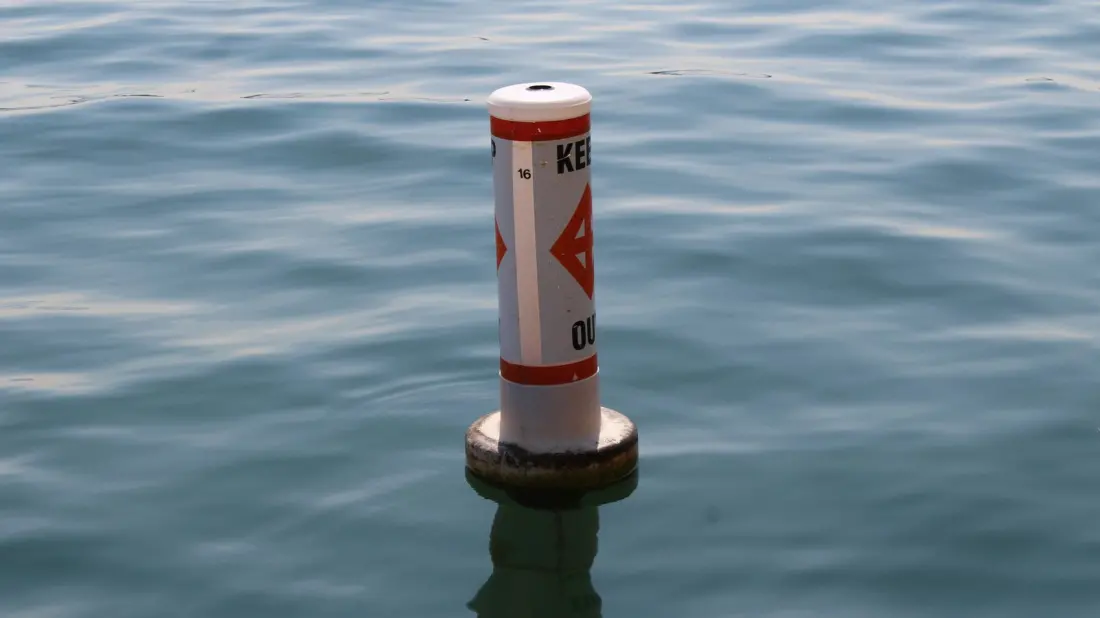
If you're renting a boat or jetski on an American lake this summer, you'll quickly meet a family of markers that don't exist anywhere else: white buoys with orange stripes and symbols. The one to take seriously is the orange crossed diamond. It's the water-based equivalent of a no-entry sign — the area beyond it is closed to boat traffic entirely.
These markers are part of a set of four white-and-orange "special purpose" buoys used only on inland waters in the United States. They're not part of the international IALA system that governs red-and-green navigation markers at sea, which is why you won't spot them cruising in the Caribbean or elsewhere — just on reservoirs, rivers and lakes across the US. All four types look similar: solid white with two horizontal orange stripes and an orange symbol between them, sometimes with black lettering spelling out specifics. The symbol is what carries the core message.
So where do keep-out buoys show up? Dams and spillways are the classic spot — currents there can be dangerous when water is being discharged, so you'll often see a line of crossed-diamond buoys backed up by a physical safety boom. Designated swimming areas use the same setup to keep boats away from swimmers, and environmentally sensitive zones or protected wildlife habitats get them too.
One practical tip worth memorising: the crossed diamond isn't the only orange symbol out there. Other white-and-orange buoys warn of hazards or mark no-wake zones rather than banning entry altogether. The safe habit is to slow down as soon as you see any white buoy with orange markings and read the symbol before deciding what to do. Only the crossed diamond means turn around — but you want to know that before you're close enough to cross a line.
For holidaymakers, this is less trivia than basic safety. Boat rentals on US reservoirs come with the assumption you can read the markers, and drifting past a keep-out buoy near a dam or into a swim zone is both dangerous and likely to annoy the ranger. A minute of buoy literacy buys you a much more relaxed day on the water.