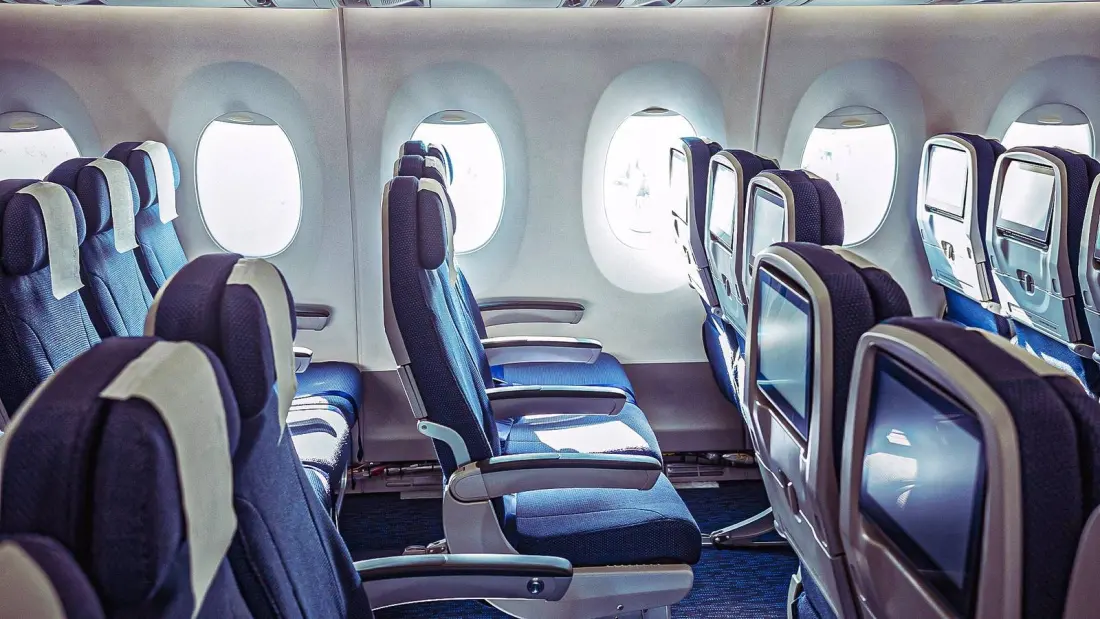
If you've ever felt wedged into an economy seat, the numbers explain why: most mainline airlines offer roughly 17 to 18 inches of width, and US widebodies often sit at the tight end of that range. But a handful of carriers — mostly in Asia — push past 18 inches, and a few hit nearly 19.
Japan Airlines is arguably the standout. It's one of the last airlines to fly Boeing 777-300ERs with nine seats per row (3-3-3) instead of the industry-standard ten, producing seats around 18.5 inches wide. It goes further on the Dreamliner: while almost everyone else squeezes nine across the 787, JAL sticks with eight (2-4-2), yielding roughly 18.9-inch seats — about 5cm extra per passenger. Korean Air also keeps nine-abreast 777s, having reversed a plan to add a seat per row after passenger pushback.
Other Asian carriers follow suit. Singapore Airlines offers around 18.5 to 19 inches on widebodies, Cathay Pacific up to 18.5, and Asiana's A380s advertise 18.9-inch seats with 33-inch pitch. ANA, which once matched JAL's eight-abreast 787s, has since reconfigured to nine but still manages about 18 inches on its three A380s.
Aircraft choice matters as much as airline choice. The Airbus A380 was designed around 18-inch economy seats as standard, and the A350 — despite a narrower cabin than the 777 — usually beats it in economy because nearly all 777 operators have crammed in a tenth seat per row. United and American's ten-abreast 777s can dip to 17 inches or less. Among narrowbodies, the five-abreast Airbus A220 is the width champion: JetBlue's A220s offer 18.5 inches on one side and a full 19 inches in the middle block, while Delta, its largest A220 operator, offers 18.6 inches. Even Southwest manages a comparatively generous 17.8 inches on its 737 MAX 8s and retrofitted -800s, thanks to slimmer armrests and thinner seat backs — notable given the 737 cabin is seven inches narrower than an A320's.
At the other extreme sits French Bee, whose 480-seat, low-cost A350-1000s have seats just 16.7 inches wide — a reminder of what ten-abreast A350s look like. There's also a change worth knowing if you fly Southwest: until 2026 it was the only major US airline letting plus-sized passengers request a free extra seat, but as of January 2026 it now requires advance purchase of additional seats, matching the broader US industry norm.
The practical takeaway: if seat width matters to you, pick your aircraft as carefully as your airline. Book a nine-abreast 777 or eight-abreast 787 with JAL or Korean Air, an A380 with Singapore or ANA, or any A220 with JetBlue or Delta, and you'll get noticeably more hip room than on a standard US carrier's 777 — often at the same economy fare.