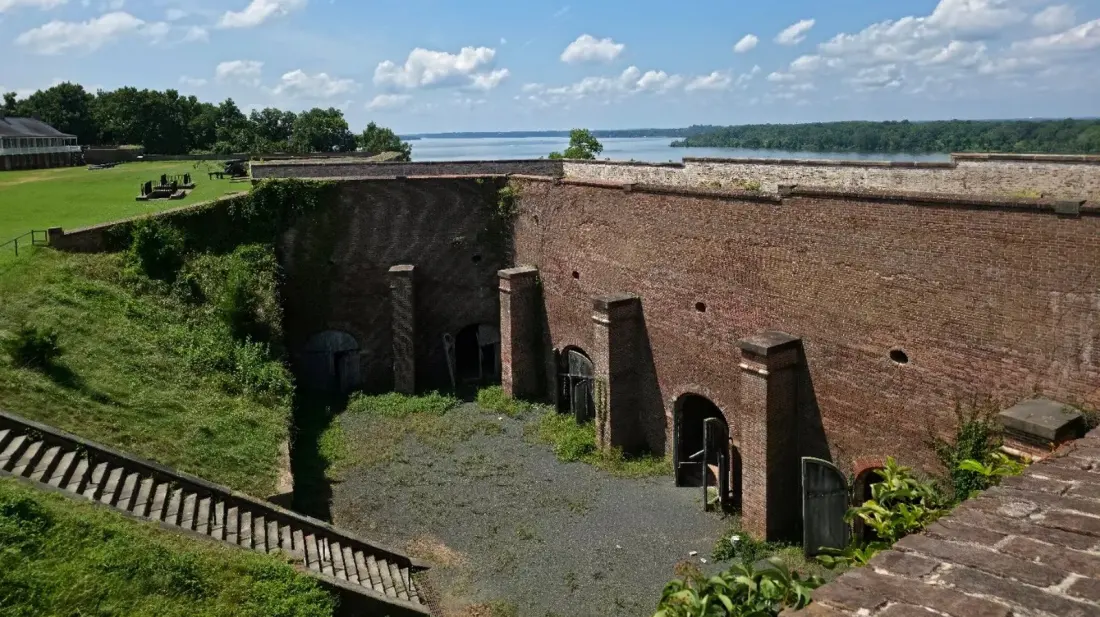
Long before radar and missile defence, the security of Washington, DC rested on a single brick fort watching the Potomac. Fort Washington, about 40 minutes south of the capital in Maryland, was the city's only major fortification until the Civil War. These days it's a National Park Service site where you can hike a riverside loop, watch Civil War cannon firings and fish for striped bass — all for free.
The backstory is a good one. An earlier fort on the site, Fort Warburton, was deliberately blown up by its own commander in 1814 as British troops marched on Washington and burned the White House and Capitol. The Army rebuilt, and the new Fort Washington was finished in 1824. It guarded the river approach through the Mexican-American War and Civil War, served as a staging point for troops heading to Europe in World War I, and trained officers during World War II before the Department of the Interior took over in 1946.
The headline activity is the 3-mile Perimeter Trail, which circles the park along the Potomac. Budget roughly three hours for it; it's mostly easy walking with a few steep climbs, and it doubles as a dog-walking and trail-running route. En route you'll pass wooded sections, the Fort Washington Lighthouse, and the remains of military batteries with names like Decatur, Smith, Meigs and Wilkin. It's remarkable how quiet it feels given the capital is under 20 miles away.
History fans have plenty to chew on. Ranger-led tours run 45 minutes and depart twice daily, at 11 a.m. and 2 p.m., Wednesday through Sunday, taking in the parade grounds and former barracks. Prefer to wander alone? Grab a self-guided brochure from the visitor centre (or use the NPS app) covering more than a dozen points of interest. The real showstopper is the artillery demonstration on the first Sunday of each month from May to November, where rangers and volunteers load and fire Civil War-era cannons.
Anglers get a solid deal too. The most accessible fishing is near the Light 80 lighthouse, where the Potomac gives up catfish, largemouth bass and striped bass — you'll generally need a Maryland tidal sport fishing licence. Birders should bring binoculars: nearly 200 species have been recorded here, from wintering waterfowl on the river to migrating songbirds in spring and autumn.
Practically speaking, the park is free, open daily from 6 a.m. to 10 p.m. (vehicles from 7 a.m.), with the fort and visitor centre open 9:30 a.m. to 4:30 p.m., Wednesday through Sunday. Driving is the easiest way in, which makes it a natural detour on a wider DC-area road trip — pair it with Alexandria, Virginia, or a day in the capital itself. It's the rare outing that mixes a genuine history lesson, a shaded hike and a riverside picnic without costing a cent.