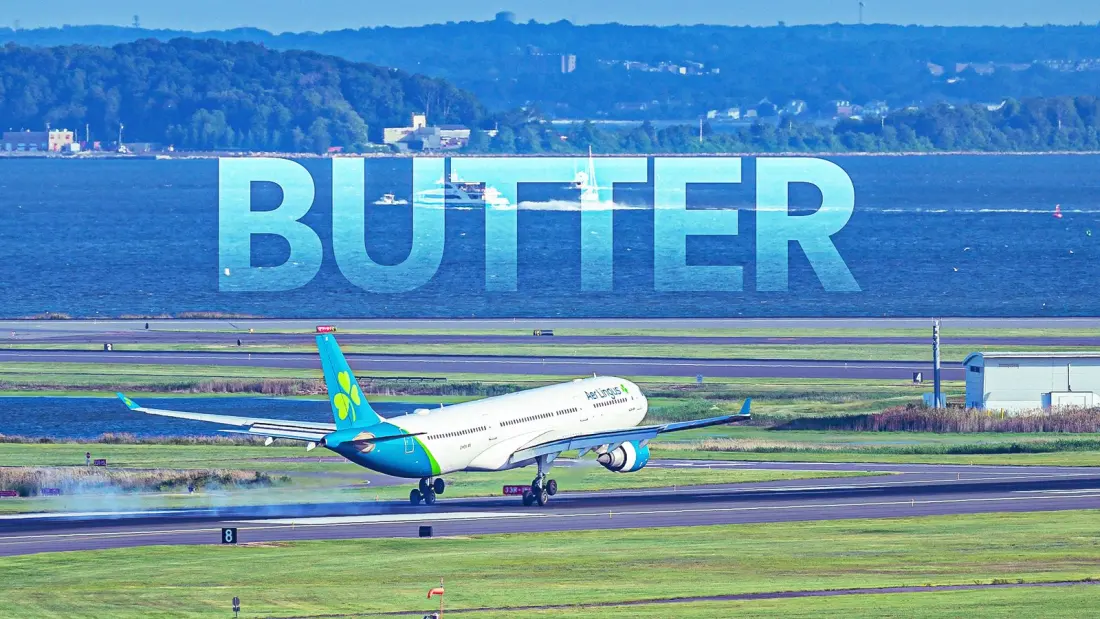
Planespotting communities have a soft spot for the Airbus A330, and not just because it's a workhorse on medium- and long-haul routes. The widebody has picked up a nickname — the "Butter Machine" — thanks to landings so smooth that the main wheels seem to kiss the tarmac rather than hit it.
The explanation starts with the landing gear. Each of the A330's two main bogies carries four wheels in a twin-tandem layout, tilted backwards so the rear tyres touch down first. That staggered contact spreads the landing forces gradually instead of dumping them through all eight tyres at once. A hydraulic ram called a pitch trimmer sets the bogie at that nose-up angle when the gear extends, and it also damps the bogie's movement through touchdown. A separate shortening mechanism tucks the shock strut up into the leg during retraction so the whole assembly fits into a compact bay.
Interestingly, engineers and pilots still debate why the tilt exists at all. Some argue it's pure packaging — the angle simply helps the bogie squeeze into its storage bay. Others say it works like the semi-levered gear on the Boeing 777-300ER, improving clearance under the aft fuselage. Either way, a space-saving solution ended up doubling as a comfort feature.
The landing gear isn't the whole story. The A330's fly-by-wire system switches to a dedicated flare law near the runway, letting pilots use the same technique as on older aircraft. Airbus recommends beginning the flare around 40 feet (12 metres) on the A330, A340, A350 and A380 — higher than the 30 feet used on smaller Airbus jets — and crews praise the type for its stable, predictable handling and slightly heavier control feel compared with the A350.
There's a catch, though. Pilots note that some A330s touch down beautifully on the rear wheels, then float before dropping the front wheels heavily. A long, graceful hold-off can look flawless from the perimeter fence while feeling noticeably firmer inside the cabin. The trick is to derotate smoothly so the front axle settles gently before reverse thrust is applied — otherwise the ground spoilers kill lift and the aircraft thumps down onto the front wheels.
The design's influence didn't stop with the A330. The A350-1000 uses a six-wheel bogie that also lands rear wheels first, and the A380 stretches the same load-spreading logic across 20 main-gear tyres. Even as the A330neo added new engines and winglets for a 14% per-seat fuel economy gain, the touchdown character stayed essentially unchanged. So next time you're at the airport fence watching an A330 glide on, you'll know exactly what's working behind that buttery arrival.