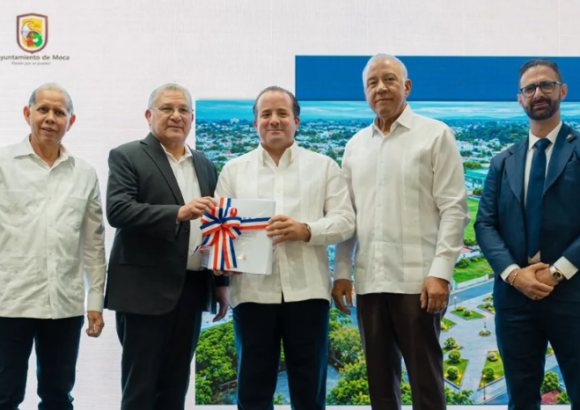
While most visitors to the Dominican Republic stick to the Punta Cana and Puerto Plata coastline, the inland city of Moca has quietly been one of the country's most productive corners — a centre for agriculture and livestock in Espaillat province, north of Santiago. Now it has a formal blueprint for how it will grow: the Municipal Territorial Planning Plan (PMOT), presented by Minister of the Presidency José Ignacio Paliza, which will steer land use across Moca and its seven municipal districts through 2036.
The numbers behind the plan are revealing. A territorial diagnosis found that more than 24 square kilometres of high-quality farmland have already been swallowed by non-agricultural uses — a red flag in a municipality that lives off the land. Flooding is another pressure point: 14.7 square kilometres of the territory sit in flood-exposed zones, and 43% of buildings are rated as highly or very highly vulnerable to that risk.
The response is a zoning split that keeps Moca fundamentally rural. Just 9.1% of the territory will be classified as urban land, with 3.2% set aside as developable reserve for future growth. The remaining 87.7% stays rural — dedicated to farming, forestry and environmental protection. The plan also sets construction guidelines for each district and bundles 108 specific actions into four buckets: environmental, socioeconomic and cultural, spatial-functional, and institutional.
Officials are framing Moca's future as an orderly, sustainable territory and a regional powerhouse for agricultural and livestock production. Practically, the PMOT should tidy up construction permitting and investment rules while shielding the farming that anchors the local economy. Residents can currently review the proposal through the Moca City Council and lodge comments before final approval, under the framework of Law 368-22 on Territorial Planning, Land Use and Human Settlements.
For travellers, why care? Moca sits in the Cibao valley heartland, and its identity is agricultural — think cacao, tobacco and livestock country rather than beach resorts. If you're the kind of visitor who prefers ranch country, road trips between Santiago and the north coast, or a glimpse of Dominican life away from the all-inclusive strip, the character of this town matters. A plan that caps urban sprawl at under 10% of the territory and protects farmland means the countryside around Moca should stay recognisably rural for at least the next decade. It also suggests any new hotel or investment activity in the municipality will face clearer rules — a small but real signal for anyone eyeing the area as an inland base between Santiago and Puerto Plata.
The seven districts covered alongside Moca are Canca La Reyna, Monte de la Jagua, El Higüerito, La Ortega, José Contreras, Juan López and Las Lagunas — names worth knowing if you're exploring the hills and valleys of Espaillat province beyond the city.
Story via Dominican Today