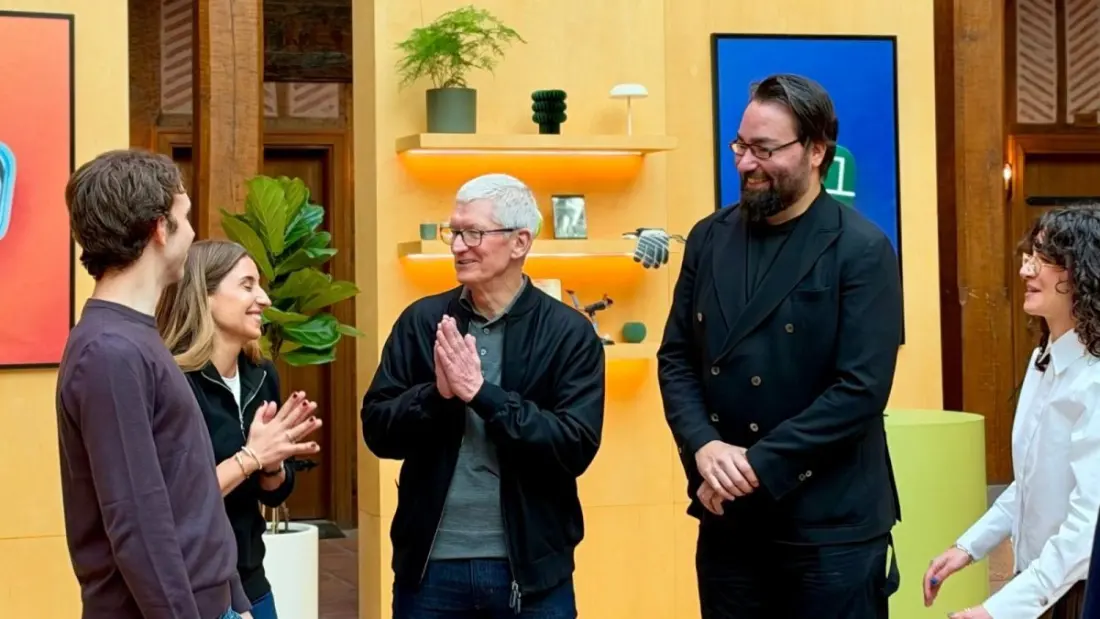
Apple's board chair Tim Cook made a quiet stop in Ankara this week that turned into something more interesting than a photo op: a sit-down with four entrepreneurs from Türkiye's software and gaming scene, each at a very different stage of the same climb.
The quartet: Rina Onur Şirinoğlu of mobile game studio Spyke, whose puzzle titles — Yarn Loop, Cube Smash, Knock Out — have cracked the most-downloaded charts in the U.S.; Eray Dinç, the director-designer behind Penalty Area, a game built for the iPhone Duo that turns the phone's folded physical form into the pitch itself, with an optical illusion making the ball glide between the two screens; Ipek Erten, developer of Kreo, a free app that lets designers build visuals by connecting nodes and see the underlying Swift code; and Can Balkaya, a teenager who earned his first money on YouTube at 12, won Apple's Swift Student Challenge, sold an app to an Italian publisher, and is now building Codz, a Mac app that bundles AI agent subscriptions into one place.
What struck the reporter most wasn't the products but the mindset. None of the four talk about "going global from Türkiye" as a goal — they design for a worldwide audience from day one. Penalty Area starts from a penalty kick, a moment every football fan on earth understands. Spyke judges markets by the lifetime value of a player rather than acquisition cost, with the U.S., Canada, the U.K., Japan, South Korea and developed Europe as priority territories. Balkaya's first customers were already in the U.S.
The other recurring theme: what they want from Apple isn't money. They're asking for knowledge and access — mentorship on localization and entering new markets, free training at the developer academies Apple plans to open in Türkiye, and one-on-one sessions with Apple engineers and designers. The upcoming Developer Center in Istanbul is expected to deliver exactly that kind of hands-on contact rather than just classroom courses.
The friction points are revealing, too. Şirinoğlu says generative AI accelerates the work but creativity and design judgment still rest with the team, and that Spyke prototypes hundreds of mechanics a year with only a few reaching commercial release. Balkaya is blunter about local hurdles: Stripe and PayPal aren't available to Turkish companies, banking and accounting software is clunky, and the incentives system is convoluted. His marketing spend outweighs his development costs. Fix the infrastructure, he argues, and there's no reason Türkiye's GDP couldn't double within a few years.
For travellers, the story is a nudge to look past Istanbul's usual highlights: the city is quietly becoming a regional tech hub, and the new Apple Developer Center will add to that energy. And if you're in Ankara on business, Penalty Area is a genuinely fun way to kill time on the flight over — just bring the folding iPhone it was designed for.
The piece also touches, almost incidentally, on Türk Telekom's Günışığı project, which uses a classroom camera-and-tablet tool called TahtApp to help children with low vision follow lessons alongside their sighted classmates in 100 schools across 25 provinces — a reminder that the country's tech ambitions extend well beyond games.
Daily Sabah Travel