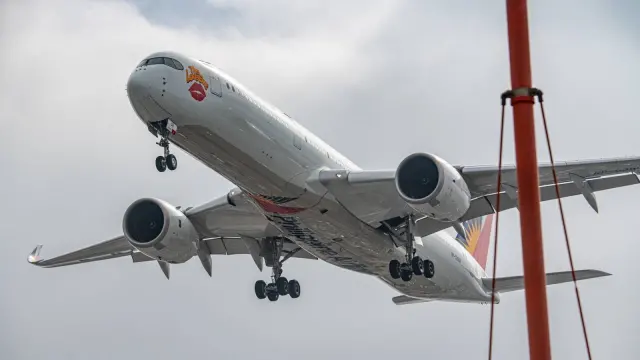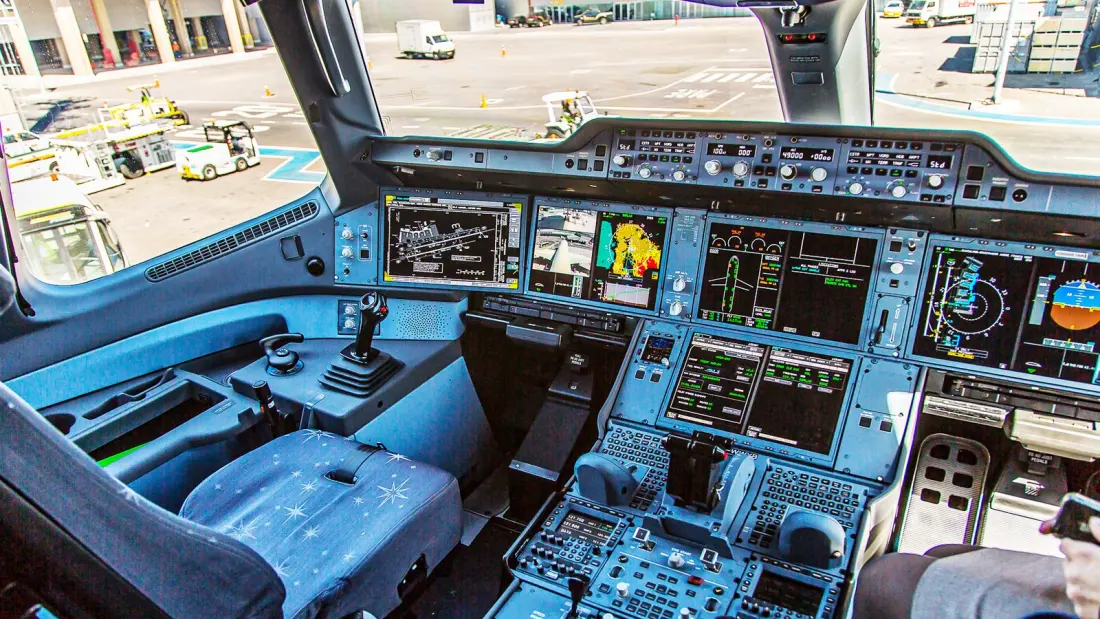
The A380's last delivery rolled out of Toulouse in 2021, but the superjumbo's biggest surviving legacy isn't parked at an airport — it's built into the cockpit of nearly every A350 flying today. Airbus has been unusually open about the fact that the A380's flight deck was the starting point for the A350's, even though the newer cockpit looks like a generational leap rather than a copy.
The most visible change is the screens. The A380 carried eight main displays plus extra panels for its onboard information system; the A350 streamlined that to six identical large-format displays, all sharing the same part number and fully interchangeable. Because information isn't locked to a specific screen, pilots can rearrange pages across the flight deck, share material during briefings, and the aircraft can automatically recover data if a display fails.
Interaction changed too. Older Airbus cockpits relied on the MCDU — a small box with its own screen and a scratchpad workflow. The A350 instead uses Keyboard and Cursor Control Units, which first appeared on the A380, letting crews move a cursor between fields and screens much like a computer. Since December 2019, some A350s (China Eastern took the first) also offer touchscreen displays on three of the six panels, kept deliberately separate from flight-critical systems.
Beneath the glass, the family resemblance runs deeper. The A350's Integrated Modular Avionics is an evolution of the A380's approach to shared computing — the newer jet can consolidate up to 40 flight-system functions on common modules versus 23 on the A380. Both jets also ditched the classic three-hydraulic setup for a two-hydraulic, two-electrical architecture.
The practical payoff for airlines is training time. A380 pilots need just a five-day course to qualify on the A350; A340 pilots take 10 days, A320 Family pilots 11, and A330 pilots can transition under a common type rating with around 60% less training. Airbus says cross-crew qualification can cut training duration by up to 78%. That flexibility is why carriers like Qantas, retiring A380s from fiscal 2032 while adding A350-1000s, can move crews between generations relatively smoothly.
For travellers, this matters in subtle ways: shorter training paths keep experienced crews flying rather than sitting in simulators, common cockpits let airlines roster flexibly across fleets, and features like Brake To Vacate — which calculates an autobrake profile to a selected runway exit — contribute to smoother, more efficient ground operations. The A350 is what Airbus built when it finally had the chance to refine the A380's ideas on a lighter, leaner airframe. The superjumbo's cockpit may be disappearing from skies, but its design DNA is now flying more routes than ever.