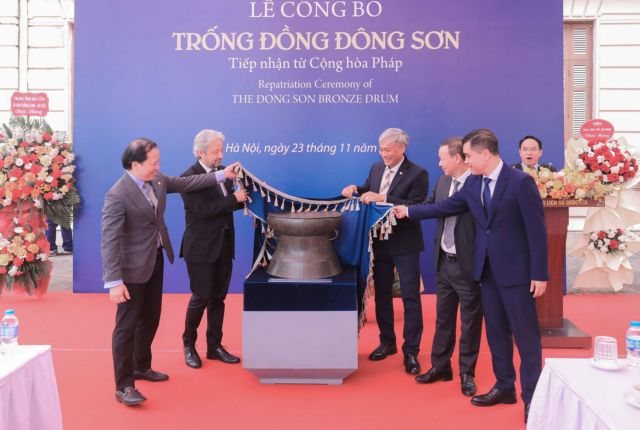
After more than a decade in France, an authentic Đông Sơn bronze drum has been returned to Việt Nam and is now at the National Museum of Vietnamese History in Hà Nội, where it was formally received on November 23 — Việt Nam Cultural Heritage Day.
The story of this drum reads like a detective file. French customs officers discovered it on August 26, 2014, on a flight from Dakar, Senegal, transiting through Spain and heading for Rennes. With no valid import paperwork, it was seized in Brittany. A Rennes court ordered its confiscation in November 2015, and the Rennes Museum of Fine Arts kept it safe for years afterwards. Once Vietnamese authorities traced its origins, experts confirmed it belonged to the Đông Sơn bronze drum tradition — a bronze-casting culture that flourished in northern Việt Nam from roughly the third to the first centuries BC.
The handover itself carried political weight: it took place at the French Ministry of Culture in September 2026, during an official visit by Party General Secretary and State President Tô Lâm, with French Culture Minister Catherine Pégard and Vietnamese Deputy Minister Tạ Quang Đông present. The case is being held up as a model of cultural diplomacy and cross-border cooperation against illicit trade in cultural property, in line with the 1970 UNESCO Convention.
So what exactly came home? A drum about 40.8cm tall with a face just over 53cm across, weighing 17.85kg. Its face bears a 12-rayed sun motif ringed by stylised peacock feathers and geometric bands; the body is divided into seven panels with herringbone dividers, and it has four double handles with rope-like decoration. It was cast using a three-part mould technique, and lab analysis of the copper-lead-tin alloy matches materials used in the Đông Sơn period. Notably, it is unusually thin and light for a Đông Sơn drum — classified as Heger I, Group B — which experts say adds new insight into just how varied and sophisticated ancient Vietnamese bronze casting was.
For travellers, this matters soon: the museum says it is preparing to put the drum on public display after completing documentation and preservation work. If you're visiting Hà Nội, the National Museum of Vietnamese History at 1 Tràng Tiền, steps from the Hanoi Opera House, is already one of the city's best stops for ancient artefacts — and in future it will house one of the most celebrated repatriation stories in Southeast Asian archaeology. Pair it with the Vietnam National Museum of History's Bronze Age collections or a day trip to the Red River Delta, where Đông Sơn culture originated, to see the wider context of this remarkable object.