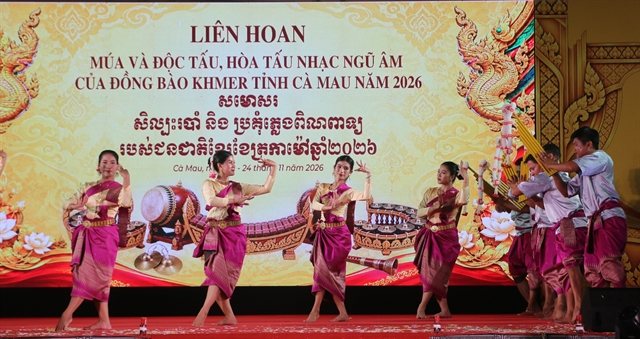
For three nights in late November, the courtyard of Xiêm Cán Pagoda in Cà Mau Province, at Vietnam's southern tip, filled with the clang of gongs, xylophones and barrel drums. More than 130 Khmer performers from nine troupes gathered there for the Khmer Dance and Ngũ Âm Music Festival, held November 22-24 as part of the province's Việt Nam Culture Day celebrations.
The event doubled as a showcase for Ok Om Bok, the moon-worshipping festival that ranks among the three big annual celebrations of the Khmer people in southern Vietnam, held in the tenth lunar month. Each troupe staged three pieces: a solo instrumental performance, a ngũ âm ensemble piece, and a Khmer dance such as rô băm, the circular rom vong, or the chhay-dăm drum dance.
Ngũ âm — known elsewhere as Pinpeat — is the ceremonial ensemble you'll hear at Khmer pagodas and during major festivals like Chol Chnam Thmay and Sen Dolta. It's percussion-heavy by design: roneat (bamboo or wooden xylophones), kuong vong (tuned gongs set in a circular frame), skor (barrel drums) and chhing (small hand cymbals).
Officials from the provincial culture department framed the festival as more than a competition. Ngũ âm music and folk dance sit at the centre of Khmer community life in the south, tied to village gatherings and temple rituals, and they carry the community's script, moral values and heritage. The event also aims to honour older artisans and give them a stage for passing the traditions to younger performers — several troupes came from rural communes like Hưng Hội, Thanh Tùng and Hồ Thị Kỷ, plus the province's Ethnic Boarding High School.
Why should a traveller care? The Mekong Delta's Khmer culture is easy to miss if you stick to the big cities. Cà Mau sits hours from Cần Thơ, and its Khmer pagodas — Xiêm Cán among them — are living cultural venues, not museum pieces. Time a visit around the tenth lunar month and you may catch Ok Om Bok celebrations, with boat races, moon offerings and music very much like what was performed at this festival. Even outside festival season, pagoda courtyards in the province regularly host community performances, and locals are generally happy to explain what you're watching.
The festival wrapped on November 24, but the traditions it celebrates run year-round across the Khmer communities of the delta.