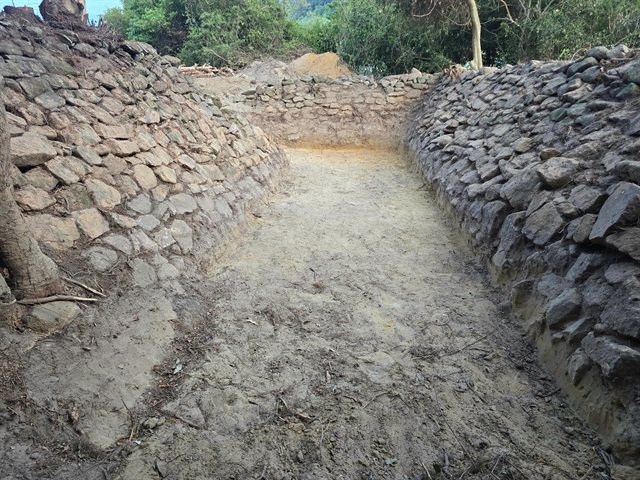
Two forgotten military posts from the Nguyễn Dynasty have just been given official heritage status in Đà Nẵng — and they add a genuinely interesting historical stop to one of Vietnam's most scenic drives.
The city has recognised the Chơn Sảng Garrison and Nam Chơn Station as a city-level mixed relic, its first such designation since Vietnam's updated Heritage Law came into force in 2024. The two defensive posts, built in the 19th century, sat on the old Thiên Lý north–south route through the Hải Vân Pass, about 20km north of the city centre, and played a role in regional defence when a French-Spanish coalition attacked Đà Nẵng from 1858.
Archaeologists working across a 600-square-metre excavation uncovered 964 artefacts. The first batch of 88 — ceramics, terracotta and stone pieces — has already gone to the Đà Nẵng Museum for storage and study. The posts even appear on a defence map from the reign of King Tự Đức (1847–1883), recorded by French cartographers as fort royal de Nam Kin and fort de Kien-Chang.
They're part of a broader cluster of military heritage in the area. Nearby at the top of the pass stands the Hải Vân Gate, a brick fortification dating to around 1826 under King Minh Mạng, which became a national relic in 2017 and was fully restored in 2025. In the city itself, the Điện Hải Citadel — built under King Gia Long to guard the strategic seaport on the Hàn River, along with the An Hải fortress across the water — was named a National Special Relic in 2019. Đà Nẵng also maintains the Y Nha Pho Cemetery, a French-Spanish burial ground near Tiên Sa Port at the foot of the Sơn Trà Peninsula, a quiet reminder of the 1858 invasion.
For travellers, this is a good excuse to slow down on the Hải Vân Pass, the coastal mountain road between Đà Nẵng and Huế that's already popular with motorcyclists and road-trippers. Beyond the famous viewpoints, you can now layer in the restored Hải Vân Gate at the summit and, in time, the newly excavated post sites below — a route that reads as a timeline of Vietnamese coastal defence. History-minded visitors can pair it with the Điện Hải Citadel and the Sơn Trà Peninsula, where the old cemetery and a small chapel sit near beaches and the Linh Ứng Pagoda area.
The heritage listing matters practically too: it puts the sites under formal preservation, so expect better access, signage and possibly museum displays as research on those 964 artefacts continues. If you're planning a Đà Nẵng trip in the next year or two, the Hải Vân corridor is shaping up to be more than just a pretty drive.