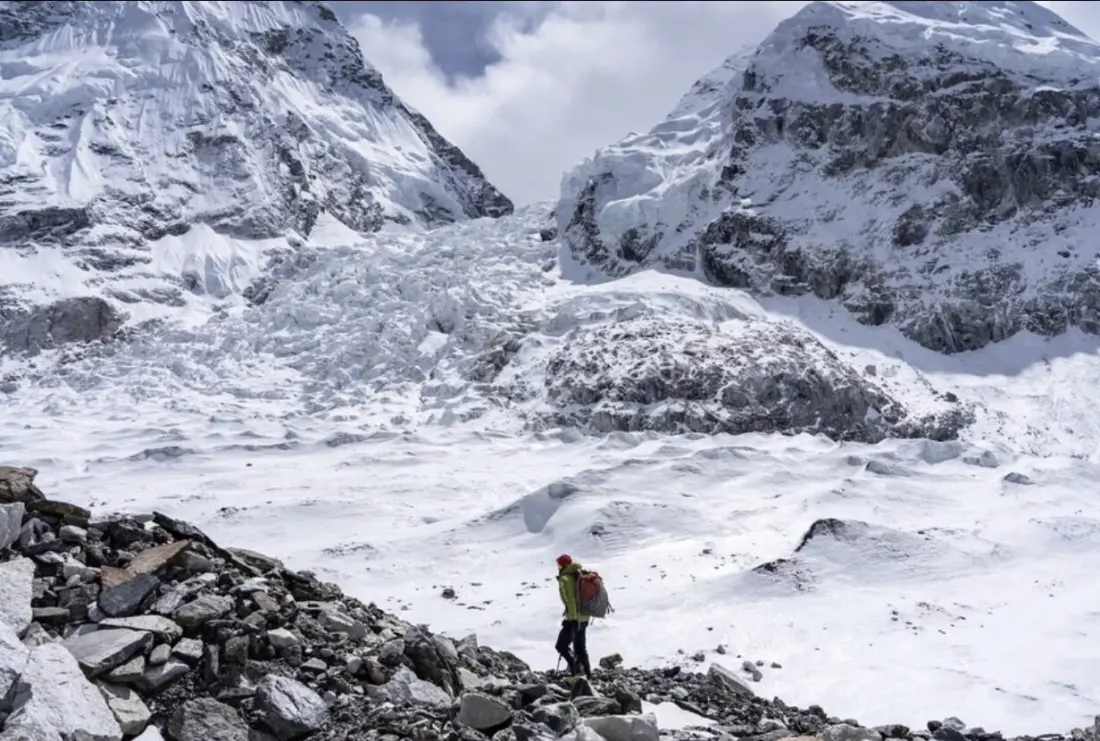
There is exactly one team on Everest right now, and they've just chosen the hard way up. A four-person Russian group — Andrei Vasiliev, Sergey Kondrashkin, Vitaly Shipilov and Natalya Belyankina — has set off into the Khumbu Icefall out of season, when the route that hundreds of spring climbers rely on is nothing but raw ice: no fixed ropes, no ladders over the crevasses, no sherpa infrastructure. Everything above them is effectively unmarked territory.
The team had been warming up with an acclimatisation push toward the Nuptse shoulder, to the right of the icefall. Heavy snow slowed the climb, and they ended up bivvying at 5,650 metres before dropping back to their base in Lobuche to weigh their options.
There were two on the table. The first was the obvious one in name only: forcing a path through the Khumbu Icefall, the serac-riddled glacier crossing that guards the standard route. The second was considerably more left-field — the Lho La, a pass on the left side of the Khumbu Glacier that would give them access to Everest's West Ridge. That line is a familiar reference point for solo alpinist Jost Kobusch, who has made several attempts at it in winter conditions. In the end, Vasiliev told Mountainclub the decision was made: "We're heading up, attempting to get through the Khumbu Icefall. We'll see how things go from there."
The plan is a six-day stint on the mountain. Notably, they haven't committed to a summit push at all — this could end as a partial route or acclimatisation exercise, with the real objective saved for later. That kind of open-ended approach makes sense in the current conditions, where deep fresh snow adds avalanche risk to an already technical problem and there's no safety net of fixed lines.
For anyone who's trekked the Khumbu or gazed up at Everest from base camp, it's a striking reminder of how different the mountain is outside the narrow April-May expedition window. The icefall that becomes a well-trodden, ladder-bridged highway in spring is, right now, a puzzle the Russians have to solve on their own terms. Even experienced guides avoid it unplugged — crossing it requires reading crevasses, timing moves around serac fall, and placing all your own protection.
Why should a regular traveller care? Mostly because it reframes the region. The Khumbu Valley — Lobuche, base camp, the viewpoints around Nuptse — is one of the world's great trekking playgrounds, and it doesn't close when the climbing circus leaves. Autumn and winter bring quieter trails, crystal-clear skies and a completely different Everest than the crowded summit-queue season. And stories like this one are a good reminder that the mountain's drama continues year-round, whether or not anyone is watching.
We'll be watching to see whether the team turns their six days into a summit bid or banks the experience for a later attempt.
Story via ExplorersWeb.