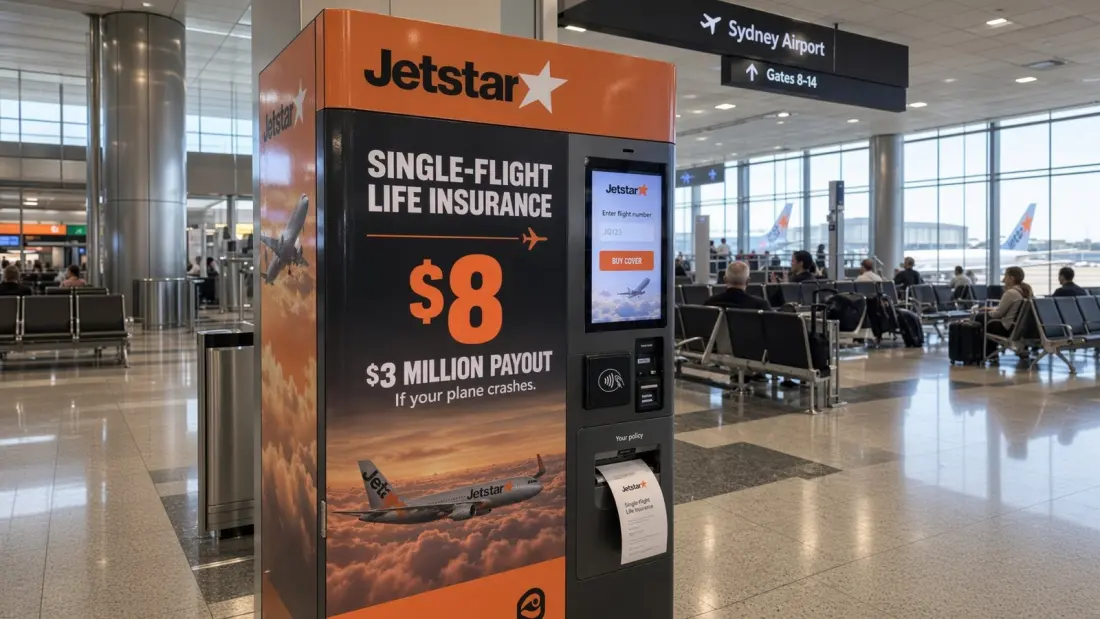
A viral image recently circulating on Twitter shows a Jetstar-branded airport vending machine offering $3 million in life coverage for a single $8 flight. The picture looks AI-generated and Jetstar has no such product — but the premise isn't fantasy. Flight insurance machines were once a genuine fixture of airports, and their history is stranger and darker than most travellers would guess.
Passenger flight coverage dates back to 1919, when Travelers sold Woodrow Wilson a $5,000 accidental death policy for $5. By 1946 the first coin-operated machines appeared at New York's Central Air Terminal, and staffed counters soon followed as demand outgrew what ticket agents could handle. At its peak, Mutual of Omaha's Tele-Trip operation ran roughly 100,000 policies a year through 90 US and seven Canadian airports, mostly via kiosks and drop boxes. Machines survived into the 1980s and 1990s before airport rents and online sales squeezed the business out.
The grim twist: the vending machines occasionally handed murderers their motive. In 1949, Albert Guay had Canadian Pacific Flight 108 bombed to kill his wife and collect C$10,000 — all 23 aboard died, and he was executed. In 1955, Jack Gilbert Graham bombed United Flight 629, killing his mother and 43 others, with a $37,500 flight insurance policy found naming him as beneficiary. Thomas Doty bought heavy coverage before bombing Continental Flight 11 in 1962, killing 45. In 1964, Francisco Gonzales purchased $105,000 of coverage at San Francisco airport before allegedly shooting the pilots of Pacific Air Lines Flight 773. And as recently as 2002, Zhang Pilin bought seven policies from six insurers before setting a fire that downed China Northern Flight 636, killing 112; his family's subsequent claim failed. Colorado banned the vending machines after one of the bombings.
Here's the economic punchline: the pricing in that fake Jetstar image is actually plausible. Between 2018 and 2022 there was roughly one passenger death per 13.7 million boardings worldwide — about one in 80 million in safer countries. An $8 premium on a $3 million payout yields an average of just 22 cents per policy. The problem was never actuarial risk; it was rent, and the awkward marketing message that reminds people about mortality right before boarding.
For today's traveller, the product largely still exists in other forms: Travelex sells flight accidental death coverage up to $1 million, airline booking flows push trip coverage, and credit cards often include it free. The old machines linger in a few airports worldwide, but nobody needs to feed coins into one at the gate. The story is a reminder of how safe flying has become — insurers will happily bet millions on your survival for the price of a sandwich, and even the worst abuse of that bet couldn't dent the odds.