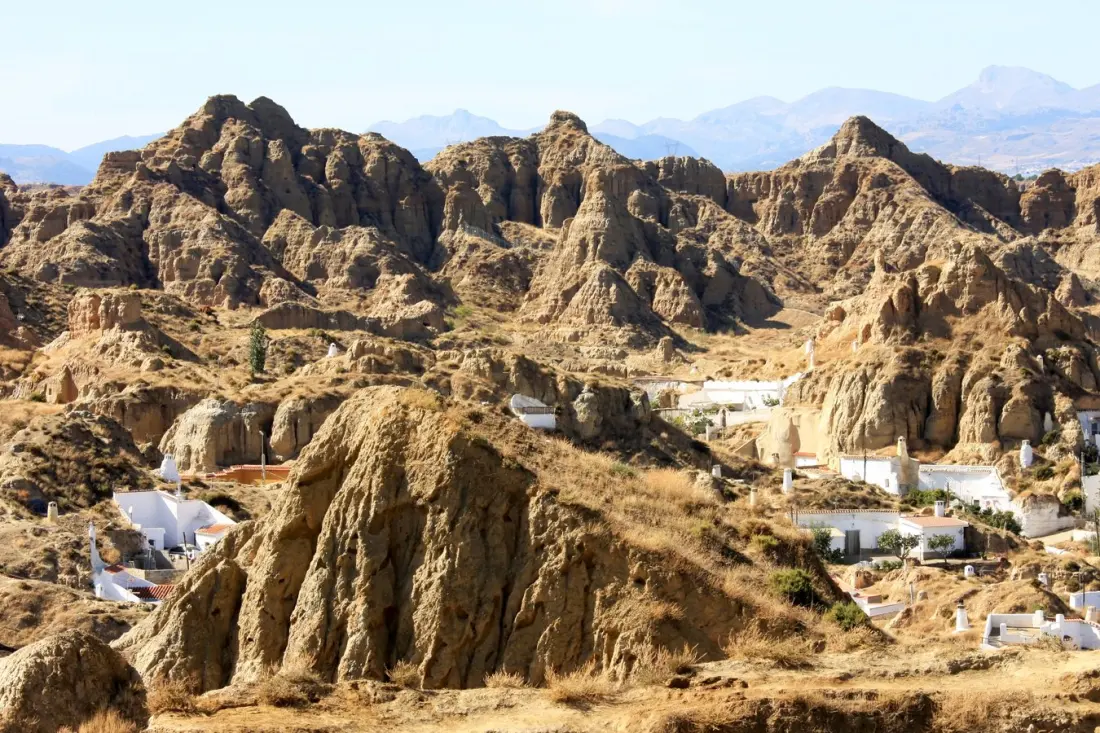
Forty minutes from Granada, the ochre hills above Guadix are dotted with white chimneys and front doors that lead straight into rock. This is the Barrio de las Cuevas, one of Europe's largest inhabited cave districts, where more than 2,000 of the town's residents still live underground — and roughly 4,000 people call the cave quarter home overall.
The caves have a tangled history. Guadix itself dates back to the Bronze Age and got its Roman start when Julius Caesar founded a colony here in 45 BC. Historians believe the cave dwellings took off around the 15th century, when Moors displaced after the fall of Granada in 1492 retreated into the hills and turned shelter caves into permanent homes. Centuries of Phoenician, Iberian, Muslim and Christian influence shaped what you see today.
The practical genius of a cave house is the temperature: a steady 18-22°C (64-72°F) year-round, no heating or air conditioning required, even when it's over 38°C outside. Inside, rooms are rounded, dim and remarkably quiet — guests often describe a night in one as gentle sensory deprivation. Several dwellings now operate as B&Bs and Airbnbs if you want to try it yourself.
Beyond sleeping in one, there's plenty to do. The Guadix Caves Interpretive Center (about €5) is a furnished period cave home showing how these spaces are dug from the soft local stone. Resident families with deep roots in the quarter are famously welcoming and sometimes offer tours of their own homes. The Mirador de las Cuevas lookout — a short but steep climb — delivers the classic panorama of white chimneys, a view that has featured in films including Don Quixote.
Upstairs Guadix is worth half a day too. The 16th-century Baroque Cathedral has an ornate façade packed with statuary and carvings, and behind it sit the bare foundations of a Roman theatre, its stones long since carted off to build the 10th-century Moorish Alcazaba. That reddish fortress offers another sweeping view over the cave district, and the cave church of La Virgen de las Cuevas holds a 400-year-old painting of the Virgin. For the ambitious, the hike to Mirador del Fin del Mundo rewards with the widest view of all — bring boots and water.
Guadix suits travellers who like their destinations a bit unexpected: history fans, slow walkers, anyone curious about how people adapt to place rather than the other way round. Budget two to three hours for the cave quarter, or half a day including the cathedral and Alcazaba. It makes an easy day trip from Granada, though staying overnight in a cave house is the real point.