Chattanooga has quietly picked up a title few cities can claim: in 2025 it became North America's first national park city, joining London and Adelaide as just the third place in the world to earn the designation from the National Park City Foundation. The honour recognises a genuine comeback — Chattanooga was counted among the most polluted cities in the US in the 1970s, and is now a legitimate outdoor hub of around 194,000 people.
What makes this work for travellers is the sheer proximity of nature. From downtown, it's under 10 minutes on I-24 to Raccoon Mountain Caverns, where you can take the two-hour guided Canyon Crawl — a middle ground between the easy 45-to-55-minute walking tour and the strenuous three-and-a-half-hour Waterfall Dome route. The cave stays a steady 58°F year-round, which doubles as a smart escape from Tennessee summer heat. Craving more underground scenery? Lookout Mountain holds Ruby Falls, the tallest publicly accessible underground waterfall in the US, reached via a glass-front elevator descending more than 250 feet. It opened in 1930, later served as a 1960s fallout shelter, and was the first US attraction to earn Green Globe sustainable-tourism certification. Timed-entry tickets are bought online, and lantern-lit tours run on select nights.
Above ground, the Lookout Mountain Incline Railway — one of the world's steepest passenger railways, hitting a 72.7% grade near the top, and ridden by Theodore Roosevelt in 1905 — climbs to an observation deck a mile up. Ten minutes away, just over the Georgia line, Rock City serves up gardens, gnome-lined trails, a swinging bridge, Lover's Leap cliff and views claimed to reach seven states.
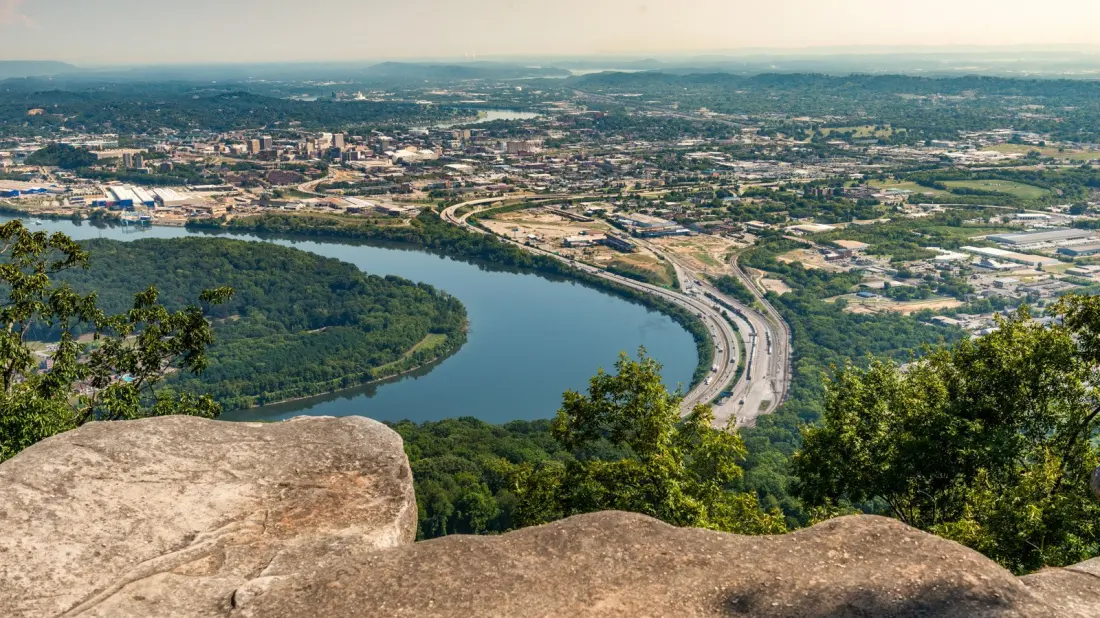
The Tennessee River shapes the city itself, horseshoeing around Moccasin Bend, the country's only national archaeological district. Nearby Prentice Cooper State Forest has 35 miles of hiking trails plus mountain biking and horseback riding, with Snooper's Rock overlooking the river gorge. The area also intersects the Trail of Tears National Historic Trail, commemorating the forced removal of the Cherokee in 1838–39; markers appear around landmarks like the Chattanooga Choo Choo, the old railway terminal turned entertainment complex, and a riverside waterfall and weeping wall near the Tennessee Aquarium honour the Cherokee, who departed from Ross's Landing.
For a lighter day, rent a kayak or paddleboard from L2 Outside at Coolidge Park and paddle past the Walnut Street Bridge, one of the world's longest pedestrian bridges. With the Great Smoky Mountains — America's most-visited national park — within reach, Chattanooga slots neatly into a Tennessee road trip without the crowds of the park itself, and rewards anyone who'd rather earn their views than queue for them. Source: Explore.com