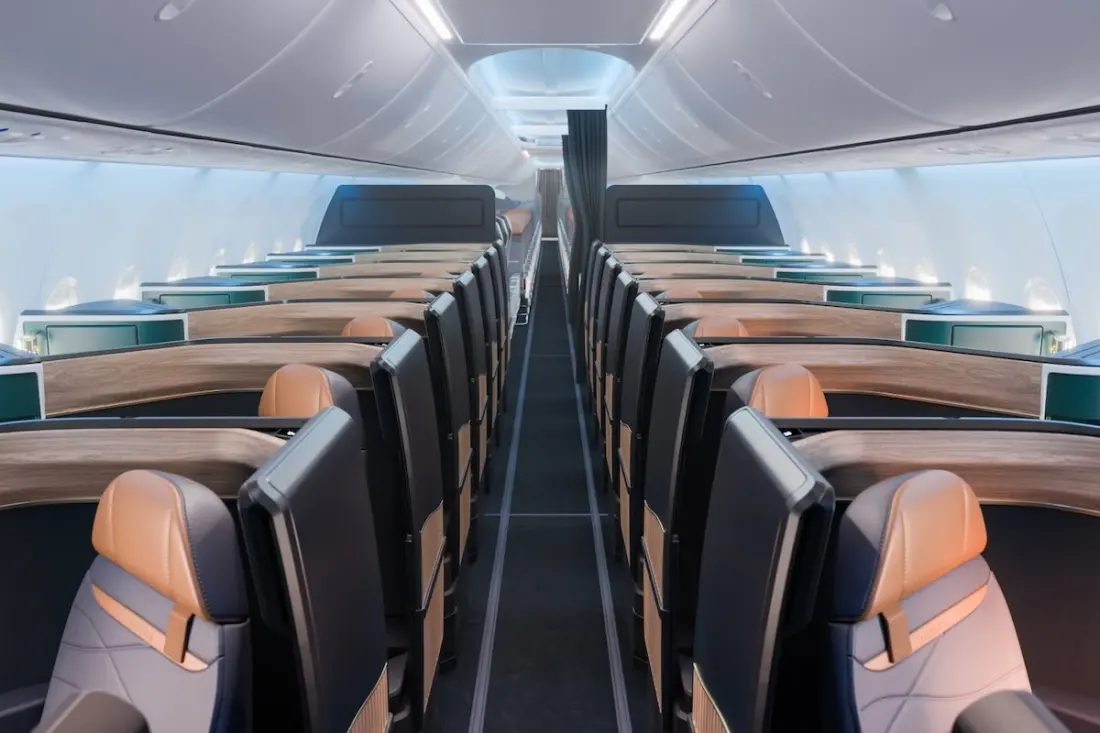
Alaska Airlines has quietly announced one of the more interesting premium products in the US domestic market: a subfleet of at least 25 Boeing 737 MAX 10s fitted with actual lie-flat business class seats, branded "Aurora Suites."
This is a first for the airline. While American and United have been pushing recliner-style business seats on their transcontinental narrow bodies for years, Alaska has held out. Now it's skipping the standard herringbone layout entirely and going straight to reverse herringbone seats with direct aisle access — the same design philosophy you'd find on many long-haul business cabins, and generally considered more private and comfortable than the herringbone seats on rival US carriers' premium narrow bodies.
Each premium 737 MAX 10 will carry 12 business suites in a 1-1 layout across six rows, plus 12 premium economy seats in a 2-2 configuration under Alaska's new "Premium Reserve" brand — a cabin also headed to its 787s and A330s. The aircraft will wear the same Northern Lights-inspired Aurora livery as Alaska's widebodies, so they'll be easy to spot on the tarmac.
Don't expect to fly one tomorrow. The 737 MAX 10 isn't due to start delivering until 2027, and Alaska says this premium configuration won't enter service until 2028. The airline has 168 MAX 10s on order in total, so the premium subfleet is a small, deliberate slice.
The stated plan is to fly these jets on transcontinental routes — think New York to the West Coast, the classic markets where flat beds have long been the norm for JetBlue Mint, Delta One and United. There's some irony here: after acquiring Virgin America, Alaska executives once insisted flat beds weren't necessary on those routes, then largely retreated from them. The economics of the MAX 10 help explain the change of heart — it's the biggest 737 variant but burns only marginally more fuel than smaller MAXes, giving airlines extra cabin space without a big cost penalty.
The open question is strategy. Alaska dominates Seattle, where Delta mostly doesn't fly flat beds against it. So is this about re-entering hotly contested New York–LA/San Francisco markets with a genuinely competitive product, squeezing more revenue from existing routes, or something else entirely? For travellers it doesn't much matter: a reverse herringbone lie-flat seat on a domestic flight is a clear upgrade over anything Alaska has offered before, and arguably over what its two biggest competitors put on narrow bodies.
One detail still up in the air: renderings of economy show no seat-back entertainment, so whether these planes get screens in the back cabin remains to be seen.
If you fly transcon regularly and value a proper flat bed, 2028 is now the date to watch.