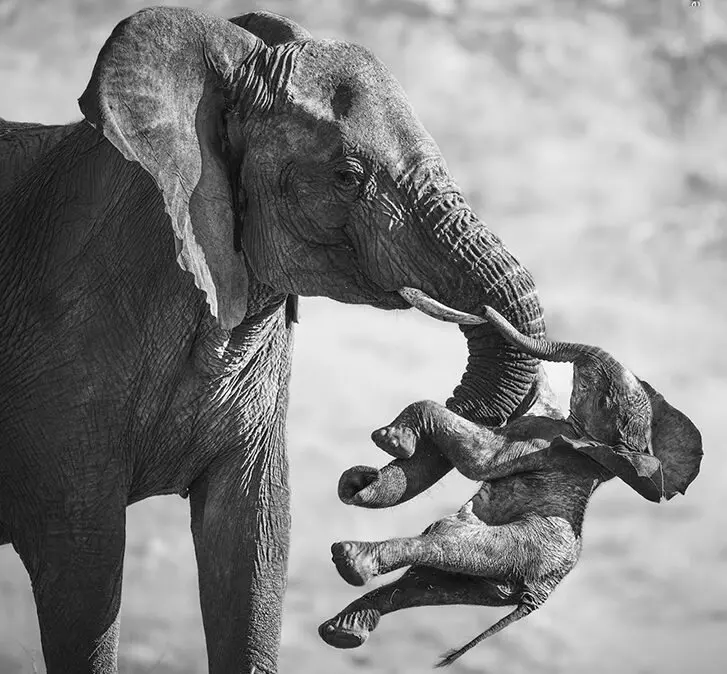
A single frame of a desert elephant carrying her dead calf has taken the top prize at this year's Wildlife Photographer of the Year awards, one of the most prestigious photo competitions in the world.
Italian photographer Federico Veronesi was tracking an elephant family through Namibia's Huab River Valley when he witnessed the female lifting and carrying the stiffened body of her calf, an act scientists interpret as mourning. The image earned him the Grand Title Winner spot for 2026, and it has an echo in the runner-up list: Norwegian Vegard Byrkjeland Aasen photographed an orca repeatedly lifting her dead calf above the water's surface. Two species, two very different habitats, the same apparently grieving behaviour.
The rest of the winner lineup travels from the microscopic to the metropolitan. German photographer Alexis Tinker-Tsavalas took the Rising Star Portfolio Award for his close-up studies of tiny, easily overlooked creatures, while Kutub Uddin went even smaller, winning the Portfolio Award with surreal macro images of slime moulds built up through focus stacking.
Several winning images blur the line between wilderness and city. Loren Elliott won the Photojournalist Story Award for documenting the roughly 100 coyotes living in and around San Francisco, whose relationship with residents is close but uneasy. In Bangkok, Seth Forestson's Urban Wildlife winner shows a common water monitor striding through a public park clutching a fish, with the city skyline looming behind it. And in the Plants and Fungi category, Agorastos Papatsanis used ultraviolet light on Mount Olympus to make the stems of Mycena renati, the beautifully named beautiful bonnet mushroom, glow neon yellow.
The next generation is represented too. Oscar Whitfield, competing in the 11-14 age group, is the Young Grand Title Winner after photographing a dung beetle at work in Zimbabwe's Zambezi National Park.
Dr Doug Gurr, director of London's Natural History Museum, which runs the competition, frames the contest as proof of photography's power to change how we see nature. For travellers, the winning images double as an itinerary of sorts: Namibia's desert-adapted elephants, urban wildlife safaris in Bangkok or San Francisco, or a detour to Zimbabwe's Zambezi National Park, where the young winner got his shot.
The full gallery is viewable on the Natural History Museum's website, and the accompanying exhibition runs in London, with tickets available online. If you're passing through the city, it's a compact way to see the planet's wild side without leaving the museum floor.
Via ExplorersWeb