Alaska Air Group has had a rough ride at the fuel pump. The airline lost $76 million in the second quarter against a $172 million profit a year earlier, with jet fuel running $4.43 a gallon — up 85% and adding roughly $600 million in costs, a spike it pins on the war in Iran. CEO Ben Minicucci told investors that fuel had erased the airline's first-half profit entirely, and 2026 guidance has been suspended. None of this is unique to Alaska, but what it did next is worth watching.
At its investor day on September 29, the airline doubled down on premium. Premium products already bring in about 35% of revenue, with a target above 40% by 2030, and non-main-cabin revenue is forecast to climb from 53% to nearly 60%. It's a bet backed by industry numbers: Delta pulled in $6.92 billion of premium ticket revenue in the June quarter — about 44% of the total, growing twice as fast as main cabin. American and United are pivoting the same way.
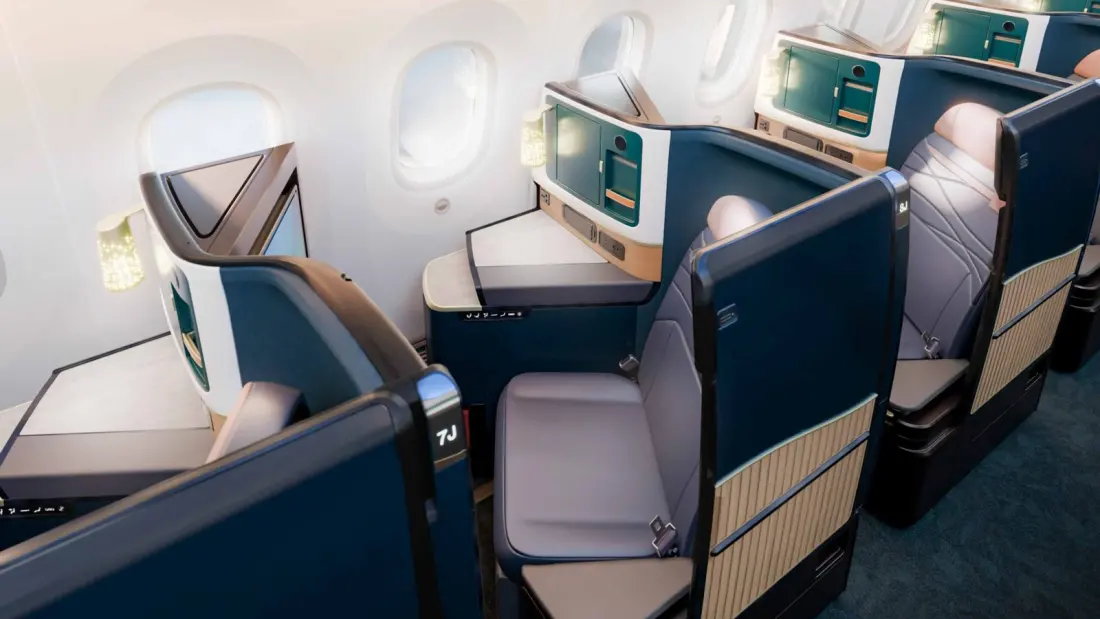
The centrepiece is Aurora Suites. Every 787-9 will carry 34 of them (40 on future 787-10s), and — more significantly — 12 lie-flat suites will go onto at least 25 Boeing 737-10s flying transcontinental routes. Alaska's 737s currently have no lie-flat seat at all, so this changes the game on flights like Seattle to Miami, a six-hour haul comparable to Boston-Dublin, plus similar-length runs to Tampa, Fort Myers and Fort Lauderdale. Seattle-Reykjavik, at over seven hours with a 7-8 hour time shift, is another obvious candidate.
The cabin ladder gets new rungs too: a Premium Reserve cabin with 38 inches of pitch and a 16-inch screen sits below the suites, while 787 suite passengers get a 19-inch 4K screen and a door. Loyalty underpins it all — Alaska expects its Atmos Rewards programme to generate nearly $4 billion in annual cash flow by 2030, with active member growth jumping from about 3% to roughly 13% a year by 2027.
The catch is timing. The 737 suites arrive in 2028, and the 737-10 itself isn't certified yet — FAA administrator Bryan Bedford said on September 28 that approval waits on a flight management computer software fix. Those jets will also skip seatback screens in economy, and Seattle's planned 500-seat Alaska Lounge plus 200-seat Aurora Lounge won't open until late next year.
For travellers, the takeaway is simple: if you fly Alaska's longer domestic or transatlantic routes, 2028 is when the front of the plane gets genuinely competitive — assuming Boeing's certification holds. Fuel is a problem Alaska can ride out; a thin premium cabin isn't, and it knows it.