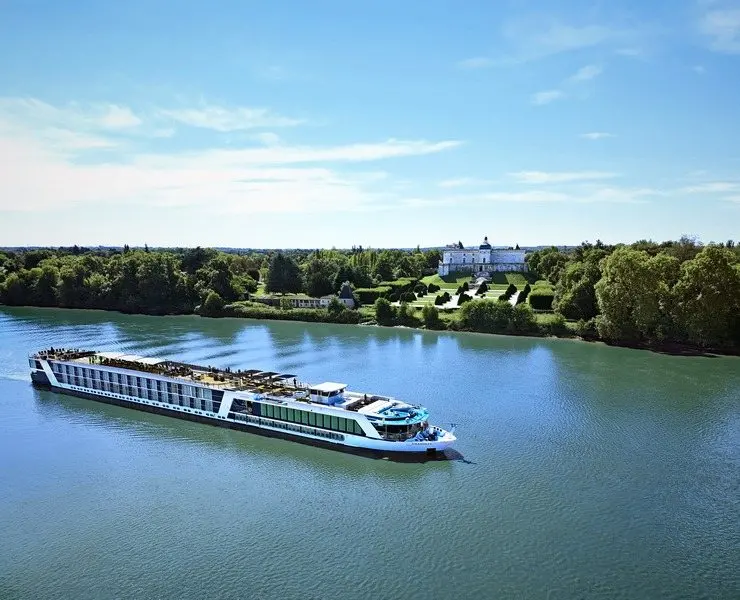
River cruise specialist AmaWaterways has mapped out an ambitious expansion: a fleet of more than 50 ships by 2032, with new vessels slated for the Nile, the Mekong, the Danube, the Rhine and the Douro. CEO Catherine Powell laid out the plan in an interview with Cruise Industry News for its 2027 European River Market Report.
The headline act is the AmaRudi, due in 2027 as the line's second double-width ship after the AmaMagna and set to become the largest river cruise ship in Europe. She carries 196 guests across 98 staterooms and is the first ship in the fleet named after a man — co-founder and chairman Rudi Schreiner. Crucially, that extra beam isn't being spent on more cabins. Powell says it buys more public space: extra dining options, expanded wellness facilities, a dedicated entertainment venue and a full-sized pickleball court on the Sun Deck. Given its size, the ship will sail the Danube exclusively, which the line frames as a plus rather than a constraint.
The orderbook through 2028 is busy. The AmaNubia launches on the Nile with 38 staterooms, with the AmaCleo adding capacity in Egypt. In 2027 the AmaMaya arrives on the Mekong with 60 staterooms and the AmaFiora joins the Rhine with 76. Then come the AmaMaria on the Danube and the AmaGaia on Portugal's Douro in 2028.
Europe remains the core of the business, but Powell flagged that 'exotic' rivers — the Nile, the Mekong, the Chobe and the Magdalena — are performing especially well. The line is also stretching its calendar: February departures on some Rhine and Danube itineraries, and Portuguese sailings running into December, including Christmas and New Year's options.
Who's booking? North America is still the biggest market, but the UK and Australia are growing, and the mix now includes more first-timers, younger guests, multigenerational groups and solo travellers — a notable shift for a category traditionally associated with older couples.
On overcrowding at hotspots like Amsterdam, AmaWaterways is making small practical calls, such as docking at Zaandam instead of the city centre. Guests face a short transfer, but the port dodges congestion and adds a lesser-known stop to the itinerary.
For travellers, this matters in a few ways. More ships and longer seasons mean better availability and shoulder-month pricing on popular rivers like the Danube and Douro. The AmaRudi's approach — space devoted to onboard living rather than squeezing in cabins — suggests what the next generation of river ships will compete on: dining variety, wellness and social space. And the strong demand for Nile and Mekong sailings is a nudge to book those earlier; capacity there is small (38 and 60 staterooms respectively) and likely to fill fast.