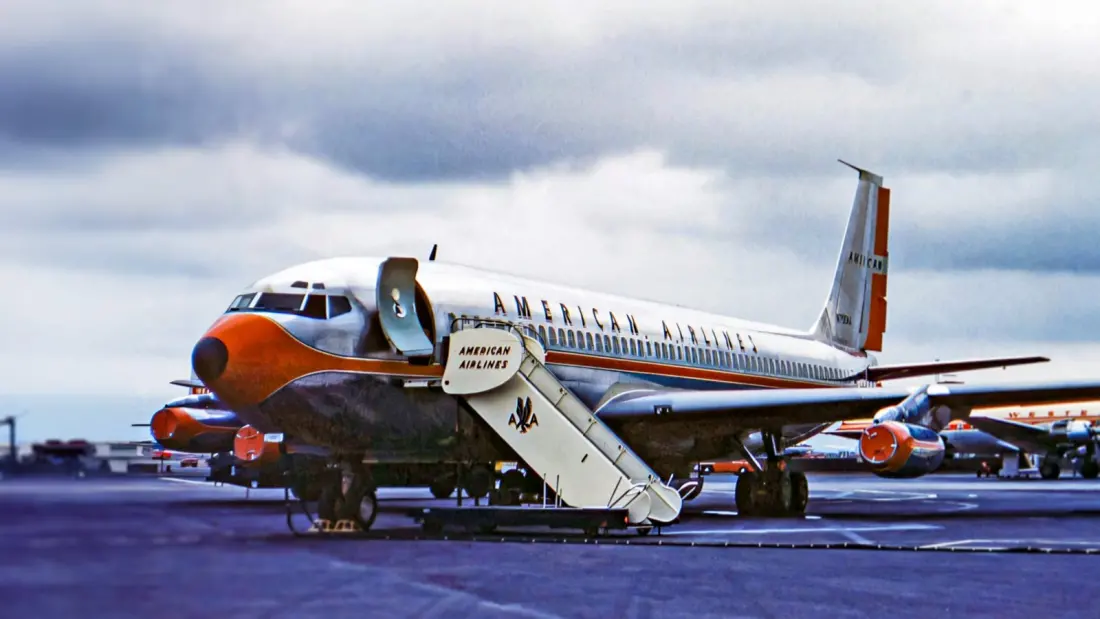
On January 25, 1959, an American Airlines Boeing 707 named Flagship California carried celebrities and WWII fighter aces from Los Angeles to New York in 4 hours and 3 minutes. It was the first time a jet had crossed the continental United States nonstop, and it cut the airline's scheduled transcontinental time exactly in half compared with its piston-engine DC-7Cs. Rivals ran full-page ads congratulating American — a rare gesture in a cutthroat era.
The milestone was more contested than it sounds. Pan Am had already flown the 707 across the Atlantic, launching New York to Paris service in October 1958 (beaten to the crossing by three weeks by BOAC's Comet 4). And just weeks before American's big day, National Airlines leased a Pan Am 707 for New York–Miami flights, stealing the 'first domestic jet' label. American pivoted its pitch: it was the first carrier to fly its own jets on the route that mattered most commercially.
Boeing's late entry helped it win. The de Havilland Comet had beaten everyone to market in 1952 but was grounded after fatal structural failures, and the Soviet Tu-104 lacked the range for profitable long routes. Boeing learned from those mistakes, hanging its Pratt & Whitney JT3C turbojets on pylons under the swept wings rather than burying them in the wing roots — improving airflow and isolating fires. The early 707-121 could fly 2,800 nautical miles unrefueled, enough for coast-to-coast nonstop, while Pan Am's transatlantic jets still had to stop in Gander, Newfoundland, for fuel. For context on how far things had come: the first coast-to-coast passenger service in 1930 took 39 hours westbound with 11 stops.
American's lead didn't last. The Douglas DC-8 entered service with Delta and United less than eight months later, and by 1961 United had overtaken American as the country's largest carrier. American's original 707 flagship, re-engined in 1961, flew 28 years before being scrapped — one of 1,010 707s Boeing built.
The reason travellers should care: the same route is still the proving ground. On December 18, 2025, American flew its new Airbus A321XLR on the JFK–Los Angeles corridor, replacing the older A321T and dropping the standalone first-class cabin in favour of 20 sliding-door Flagship Suites, 12 premium economy seats and 123 main cabin seats — carrying 38 more passengers than the 1959 jet, which needed four crew in the cockpit and 11,000 feet of runway. Boston–Los Angeles and JFK–San Francisco have followed. Sixty-six years apart, both aircraft were designed for the same basic job: getting you across America before the day is over.