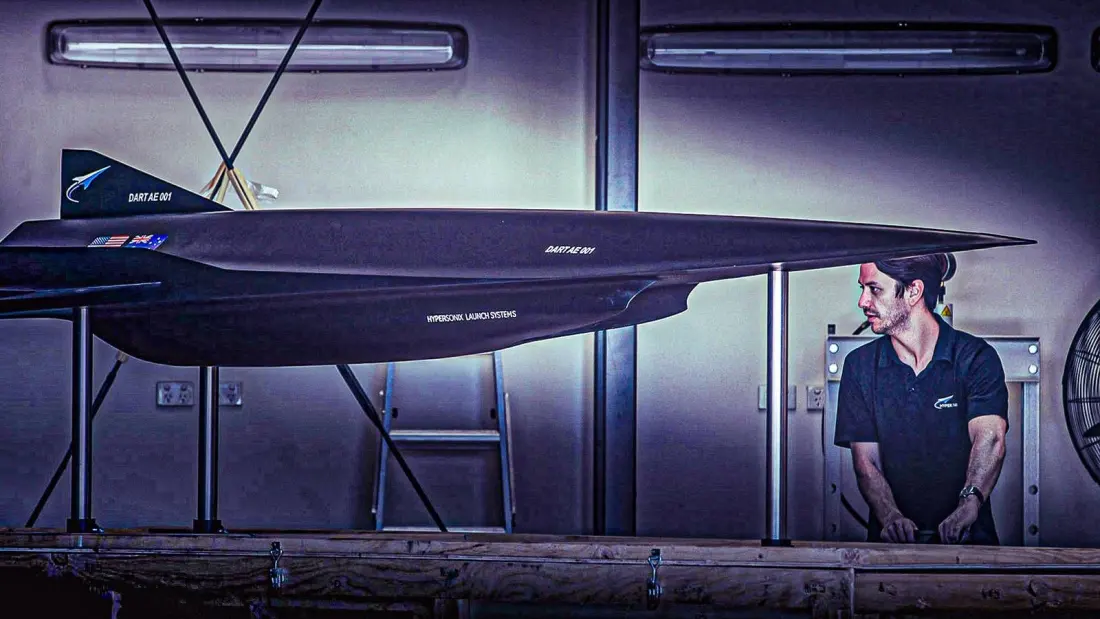
A three-metre Australian drone is chasing speeds of Mach 7 — and the engine behind it claims potential up to Mach 12, twelve times the speed of sound. It's not a passenger jet, and it won't be flying you from Sydney to London in three hours any time soon, but the Hypersonix DART AE is one of the more interesting propulsion experiments in aviation right now, and its success could feed into faster, cleaner flight tech down the line.
The DART AE, built by Brisbane-based Hypersonix Launch Systems, is an uncrewed test vehicle — 9.8 feet long, 300 kilograms, with a 9-kilogram payload bay for sensors and experiment gear. Its heart is the SPARTAN, a fixed-geometry scramjet that burns green hydrogen while scooping oxygen straight from the atmosphere. Scramjets can't start from a standstill: the drone has to be boosted to roughly Mach 5 by a rocket before the engine can ignite itself. In the US, that job falls to Rocket Lab's HASTE suborbital platform, launching from NASA's Wallops Flight Facility in Virginia under the Defense Innovation Unit's HyCAT programme, with Kratos Defense working on alternative booster options.
Why hydrogen? The fuel ignites quickly across a wide range of conditions — handy when you have milliseconds to burn it — and packs serious energy per kilogram. Cold liquid hydrogen can even double as coolant, drawing heat out of the airframe before combustion. The catch: it's bulky, needs cryogenic tanks, and the plumbing demands near-flawless leak detection.
The Mach 12 figure deserves context. The drone itself is expected to top out around Mach 7 (roughly 8,350 km/h), with about 400 seconds of powered flight between 20 and 50 kilometres altitude. The Mach 12 claim applies to the SPARTAN engine's theoretical capability, not this airframe. And the 'world's first' hydrogen scramjet label needs an asterisk too: NASA's X-43A briefly hit Mach 9.6 on hydrogen back in 2004. Sustained, controlled hypersonic flight remains stubbornly hard.
So why should a traveller care? Because scramjets and hydrogen propulsion are two of the most-discussed ingredients in the future of ultra-fast, lower-carbon aviation. The DART AE itself is a single-use data collector, not an airliner prototype — but every successful flight adds real-world evidence to a field where ground testing can't fully replicate shock heating, turbulence and engine ignition. Additive manufacturing with high-temperature alloys is also keeping build cycles short, which means faster iteration. If you enjoy the idea of hydrogen-powered aviation becoming mainstream, this is one of the programmes quietly moving that conversation forward — even if the near-term payoff is more likely in defence and research than in your boarding pass.
Full credit for the original reporting goes to Simple Flying.