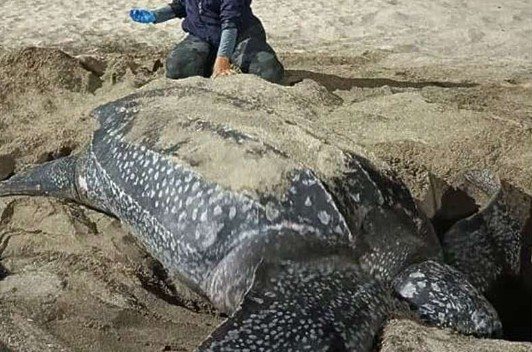
Something unusual is happening on Ecuador's Pacific coast. A new study has recorded a record number of leatherback turtle nests on Ecuadorian beaches during the 2025–2026 season — more than 1,600 kilometres south of where these turtles normally breed in Mexico and Costa Rica.
Researchers from Simon Fraser University, led by marine ecotoxicologist Juan José Alava, reviewed 45 years of records covering sightings of reproductive-age females, nests, hatching success and strandings along the Ecuadorian coast. Their findings, published in Chelonian Conservation and Biology, show a clear pattern: nesting activity in Ecuador rises during La Niña events, when sea surface temperatures in the southeastern tropical Pacific cool down. In other words, as the ocean warms overall, the turtles appear to be shifting their reproductive cycle toward coastlines that offer cooler conditions.
That's big news for a subspecies in serious trouble. Eastern Pacific leatherbacks have lost more than 90% of their population since the 1980s, squeezed by warming-driven El Niño stress, fishing bycatch, plastic pollution, boat strikes, egg harvesting and disappearing nesting habitat. Scientists had warned the eastern Pacific population could vanish within 60 years. The Ecuador nesting is being read as cautious hope rather than a recovery — but it suggests the turtles are adapting rather than simply declining.
Encouragingly, the new nests seem to be working. Egg numbers per nest and hatching rates in Ecuador are comparable to those in the traditional rookeries, and in some cases Ecuadorian nests produced more hatchlings than usual. Leatherbacks are uniquely suited to this kind of move: they're the only sea turtle comfortable in both warm and cold water, migrating thousands of miles from tropical nesting beaches to subpolar feeding grounds where they gorge on jellyfish. There are even more than 150 records of them off British Columbia between 1931 and 2024.
The researchers stress that this fragile opportunity needs protecting: ongoing monitoring, bycatch reduction and coastal zone management in Ecuador, ideally built around local and community knowledge.
For travellers, this adds a genuinely rare wildlife spectacle to Ecuador's coast — a stretch best known for fishing villages, surf towns and mangrove reserves. If conservation groups open guided viewing programmes as the colonies establish, this could become one of the few places on Earth to watch an endangered species actively colonising new ground. For now, the takeaway is simple: if you're heading to Ecuador's beaches between nesting seasons, keep an eye on local turtle-monitoring projects. Several coastal communities already run hatchery and release programmes for olive ridley and green turtles, and the arrival of leatherbacks makes those initiatives more interesting — and more worth supporting — than ever.
Just remember the golden rule of turtle encounters: observe quietly, never touch nests or hatchlings, and choose operators who follow local conservation guidelines.
Credit: Cuenca High Life