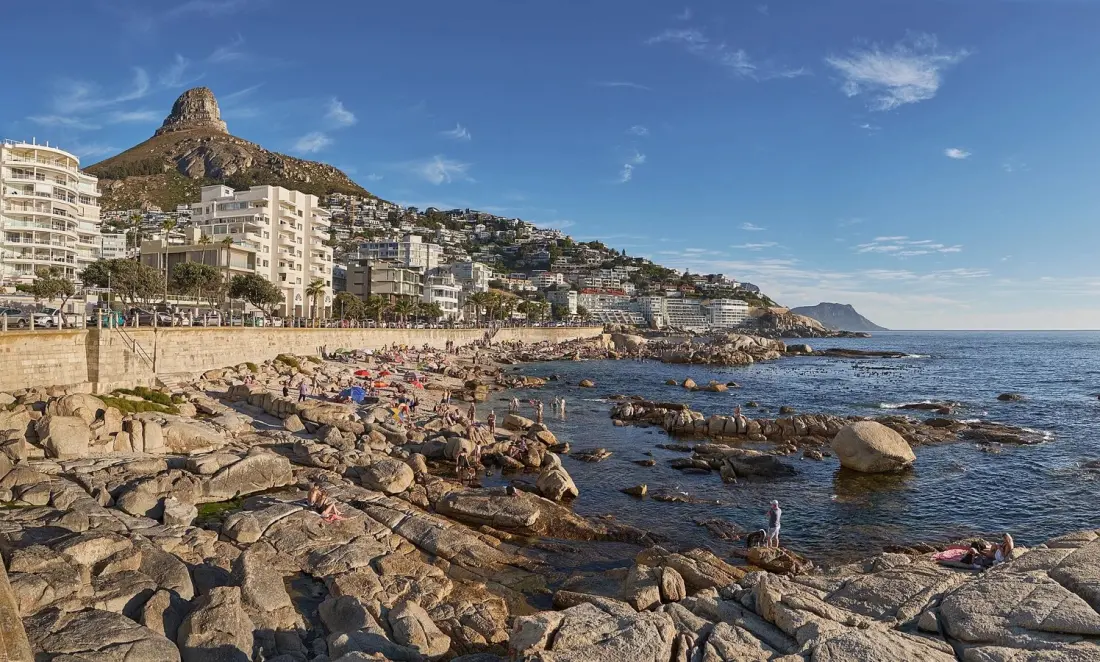
The stretch of shoreline between Queen's Beach and Saunders' Rocks in Sea Point has been a fixture of Cape Town promenade walks for generations, but it has now earned formal recognition on a global scale. The International Union of Geological Sciences announced 100 new Geological Heritage Sites on 6 November, and three of them are in South Africa — lifting the country's total to six.
The Sea Point Contact is the one you can walk to from the beachfront. In 1836 a young Charles Darwin examined these rocks, and it's easy to see why he stopped. Molten rock pushed into much older layers here and cooled into pale granite, leaving dark bands and fragments of the older rock frozen inside. The boundary between the two is visible at eye level along the shore, hiding in plain sight behind a wall of sea views.
The other two newcomers are further afield. In KwaZulu-Natal, the Nhlazatse rock section in the Wit Mfolozi River Gorge preserves ripple patterns in sandstone left by microbial mats on a tidal flat around 2.9 billion years ago. Those layered patterns turned out to be a climate record: researchers reading the changes between layers found evidence the ancient coastline crossed three different climate zones. Then there's Waterloo Farm near Makhanda in the Eastern Cape, a fossil site with an improbable backstory — around 360 million years ago this area sat within the Antarctic Circle. Fossils of two species of early four-limbed vertebrates found there proved these animals lived in polar regions, at a time when the fossil record suggested they were tropical creatures.
The trio join South Africa's existing listed sites: the Vredefort Dome, the world's largest and oldest confirmed impact crater; the Barberton Greenstone Belt, home to some of the oldest rocks on Earth; and the Kalahari Manganese Field, which produces the majority of the world's manganese.
For travellers, the appeal is that these aren't locked-away sites behind ticket booths. The Sea Point Contact sits right on a popular walking route — next time you're strolling toward Queen's Beach, give yourself a few extra minutes to look down instead of out to sea. The other two make worthwhile detours for road-trippers: the gorge section in KwaZulu-Natal and Waterloo Farm near Makhanda reward a bit of planning, with the latter best appreciated alongside its visitor storytelling around the ancient polar fossils. The list itself is a useful signal for anyone building a trip around geology or natural history — South Africa now has six world-class sites spanning a 2.9-billion-year sweep of Earth's story, from microbial mats to impact craters.