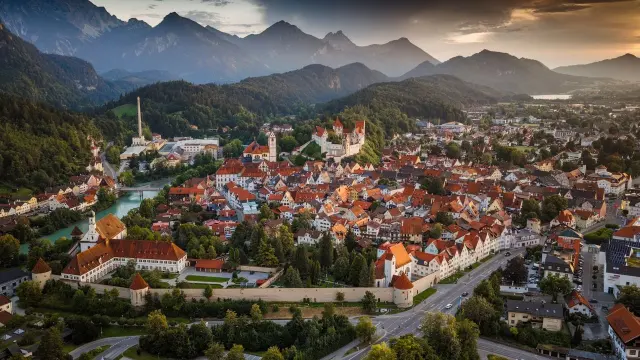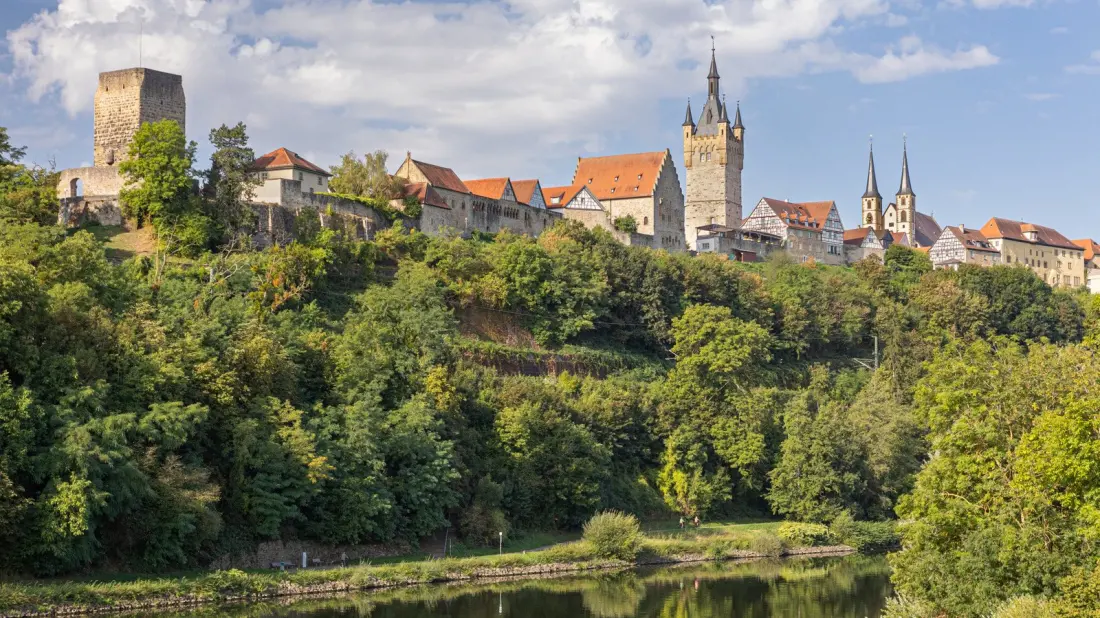
About an hour from Stuttgart by train and bus, Bad Wimpfen sits along the bends of the Neckar River looking very much like it did centuries ago. The "Bad" in the name has nothing to do with quality — it's German for "spa," a nod to the town's later life as a 19th- and 20th-century wellness retreat. Before that, it had an even longer résumé: a Celtic settlement from around 450 B.C., then a Roman fortress, and finally an imperial palace, or Kaiserpfalz, built by Emperor Frederick Barbarossa in the 12th century. That palace still anchors the old town today.
The old town itself is a gentle slope of cobblestone lanes and half-timbered cottages, with the stone Blue Tower rising over the rooftops. Climb it for views of the Neckar winding through the surrounding meadows. Start a wander on the Hauptstraße, a wide cobblestone street lined with cafes and pastel-painted facades, which continues up the hill to the Salzgasse and the marketplace. In December, the facades glow with fairy lights during the Old German Christmas Market, a tradition going back to the 15th century.
History fans have more to work with. The Steinhaus History Museum, housed in a 12th-century stone manor with a crow-stepped roof, displays carved statues, stone tools and clay pottery in vaulted rooms — though it only opens from Easter to October. At the half-timbered Tourist Information Center on the Hauptstraße, you can book the "Where Emperors and Kings Held Court" walking tour, led by a guide in medieval dress. One catch: it runs Sundays only.
Shopping and eating are easy here too. On the Hauptstraße, Veronika Prinz Boutique sells patterned notebooks, wooden bookmarks, themed playing cards (think Agatha Christie and Van Gogh), plushies and puzzles. A five-minute walk away, Beads & Art offers handmade necklaces of pearls, glass beads and colourful stones.
For food, Kräuterweible, just off the Hauptstraße, is a rustic half-timbered spot doing roast chicken with potato salad, pork schnitzel, goulash and cold platters of Black Forest ham and homemade sausage. The Anna Blume Café is another well-rated pick, with salads, cold cuts, cakes and coffee — plus a courtyard with views of the timbered cottages.
Why bother when Heidelberg is nearby? Precisely because it's not. Bad Wimpfen delivers the same storybook medieval Germany without the crowds, works perfectly as a day trip from Stuttgart, and pairs neatly with Heidelberg itself (just over an hour by train) if you want a longer Neckar itinerary. Ulm and the spa town of Wiesbaden make good add-ons further afield.