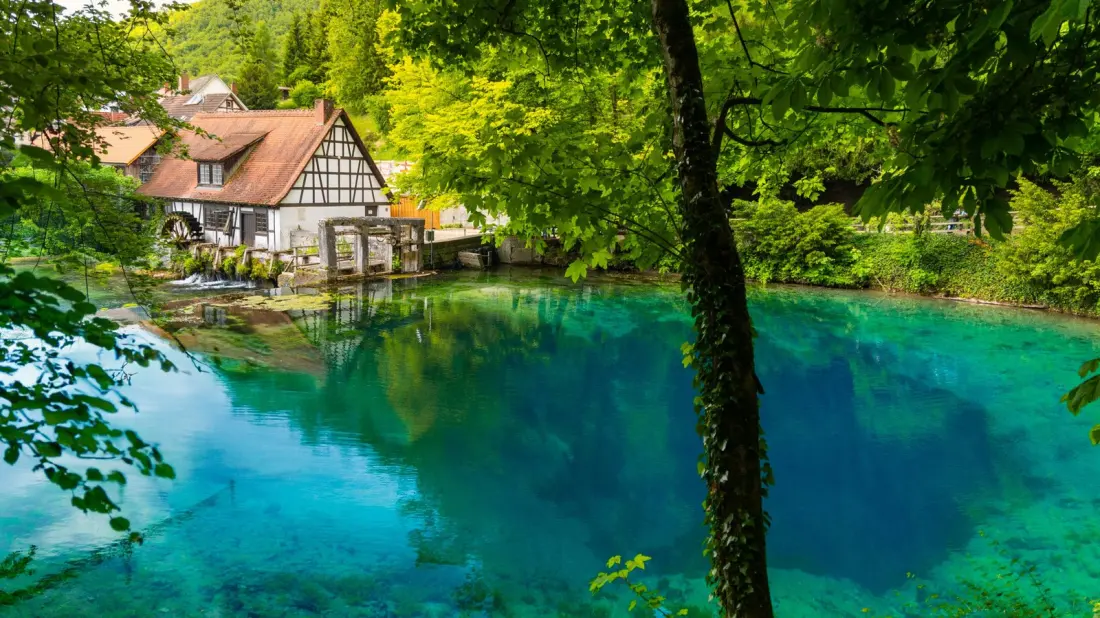
A short train ride from Ulm sits one of Germany's strangest and most photogenic natural sights: the Blautopf, a perfectly round spring in the town of Blaubeuren that glows in shades of blue and turquoise, shifting with the weather and time of day.
The spring is a quirk of the Swabian Alps, a low karst range in Baden-Württemberg. Rainwater seeps through limestone caves underground and resurfaces here through a funnel-shaped pool that drops nearly 70 feet. The colour comes from a mix of that depth and fine calcium carbonate particles in the water, which scatter light. After heavy rain the pool can visibly bubble under the water pressure; during dry spells, when fewer particles wash in, the blue turns at its most intense. Locals once believed it was bottomless, and legends grew around it — most famously the tale of the water nymph Lau, written by Romantic poet Eduard Mörike. Blaubeuren even runs family tours where a costumed guide tells the story, though only in German.
Visiting is refreshingly simple. The spring is free to see, a 20- to 30-minute walk from Blaubeuren's train station, with the historic Hammerschmiede (hammer mill) — once powered by the spring's flow — beside it. One caveat: the surrounding area is under renovation until the end of 2028, so you can't enter the mill and some parts of the grounds are fenced off, but the spring itself remains accessible.
Getting there is easy. From Ulm it's about a 10-minute train ride plus a walk through the village; from Stuttgart, allow under two hours by train or roughly an hour by car. Pair it with a stroll around Ulm itself — historic churches and Danube riverbank views — and you have a solid half-day trip.
For travellers road-tripping through southwest Germany or based in Stuttgart looking beyond the obvious, the Blautopf is a low-effort, high-reward stop: no tickets, no queues, just a pool of improbably blue water backed by folklore. Go on a clear, dry day for the strongest colour.