Borneo isn't just big — it's complicated in the best possible way. The world's third-largest island, roughly three times the size of Britain, is the only one shared by three countries: Malaysian Borneo (Sabah and Sarawak), the tiny sultanate of Brunei, and Indonesia's Kalimantan, which takes up the remaining three-quarters. Add a position at the crossroads of four seas — the South China, Sulu, Celebes and Java — and you get an island shaped by ancient migrations, trading kingdoms and headhunting lore.
Its headline act is the orangutan. Borneo hosts around 90% of the world's wild population, with the rest confined to Sumatra. Males can weigh up to 100kg, making them the largest tree-dwelling animal on Earth, and every evening they build woven sleeping platforms high in the canopy, complete with a rain 'roof'. Their famous orange fur is a neat optical trick: blazing in sunlight, it effectively vanishes in canopy shade, camouflaging them from predators. Spotting them in the wild — at sanctuaries like Sepilok or along the Kinabatangan River — remains one of Southeast Asia's great experiences.
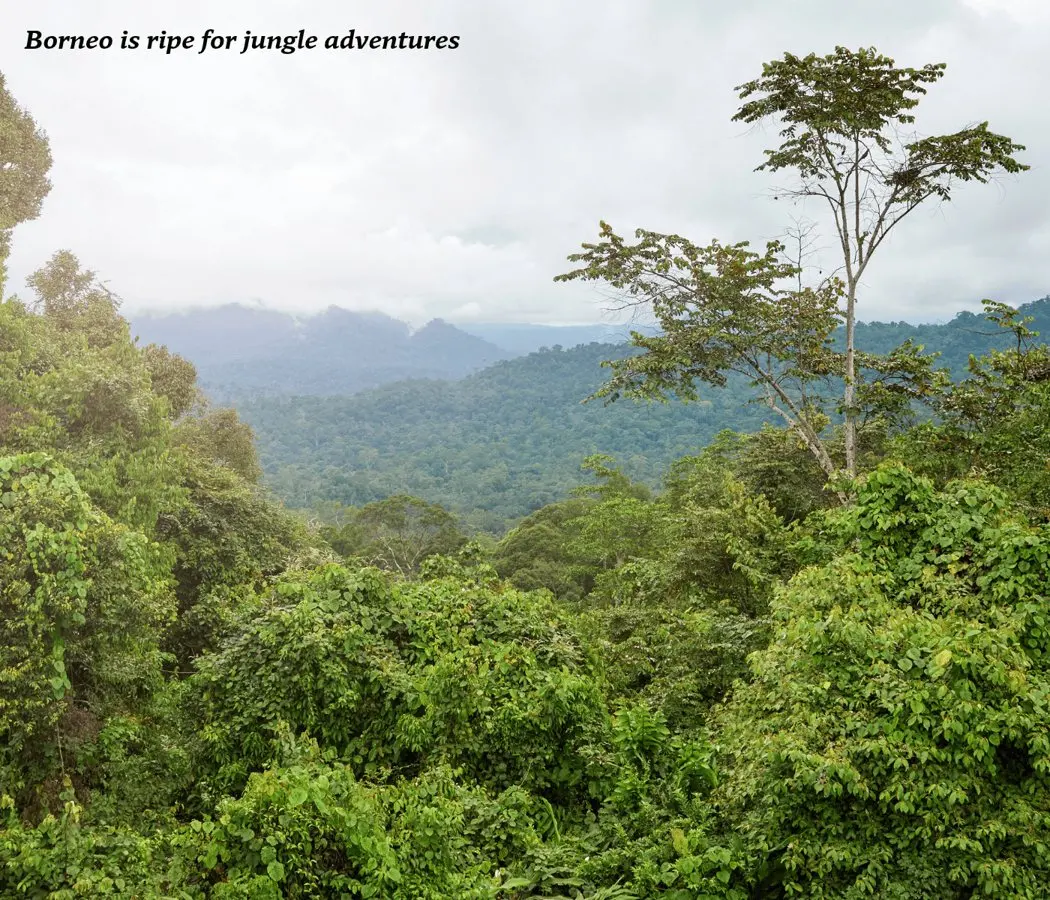
The wildlife story doesn't stop there. Borneo is a genuine biodiversity hotspot, ranking alongside the Amazon for plant richness: 10 hectares of rainforest can hold 700 tree species — as many as all of North America. Around 5,000 flowering plants and some 500 animals are found nowhere else. Then there's the proboscis monkey, endemic to Borneo, whose males sport pendulous noses that can grow to a quarter of their body length and amplify a memorable 'kee-honk' call.
For active travellers, two sites stand out. Mount Kinabalu in Sabah, a UNESCO World Heritage Site sacred to the Kadazandusun people, rises to 4,095m and passes through 12 climate zones on the way up. In Sarawak, Gunung Mulu National Park contains Deer Cave, the world's largest cave passage at 2km long — its main chamber could swallow five St Paul's Cathedrals.
Culturally, the island is equally layered: over 200 indigenous tribes, plus large Chinese, Malay and Hindu communities, and around 100 dialects spoken in Malaysian Borneo and Brunei alone. Brunei itself is a curiosity — arguably one of the last absolute monarchies, where the Sultan serves simultaneously as ruler, prime minister and head of the Islamic faith, with no elections.
One caveat for divers and snorkellers: Borneo's reefs sit within the Coral Triangle, teeming with over 1,800 fish species and five of the world's eight sea turtles, but dynamite fishing, bleaching and development have taken a toll. Choosing reef-conscious operators genuinely helps local conservation efforts.
For anyone chasing rare wildlife, jungle treks or epic caves, Borneo delivers like nowhere else in Asia — just plan for its size and remoteness.