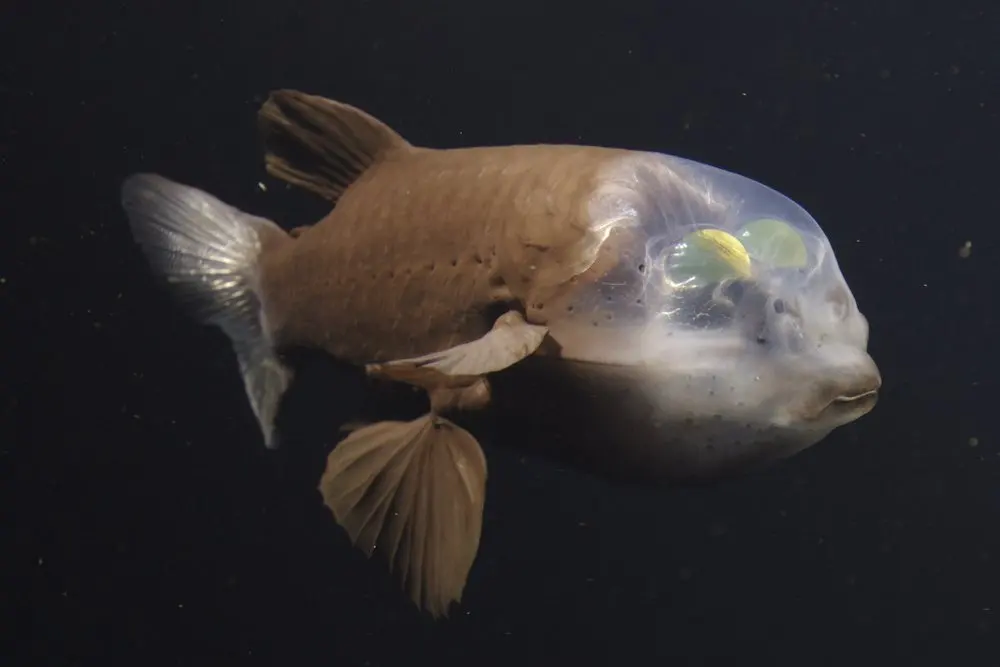
Roughly 55 miles off the California coast, at a depth of 600 metres, researchers have filmed one of the ocean's strangest residents: the barreleye fish, a creature whose head is see-through and whose tubular eyes rotate inside a transparent dome to track prey above it.
Scientists from the Monterey Bay Aquarium Research Institute (MBARI) encountered the fish during their 'Diving Deep for Delicate Drifters' expedition aboard the RV David Packard. Pilots were on their way back up with the remotely operated vehicle Doc Ricketts at the end of a long day when the fish drifted into view. It was only MBARI's 11th sighting of the species in nearly 40 years of exploration — and, remarkably, the first ever captured in 4K. The team spent around 20 minutes filming it, testing different lighting setups and even recording 3D stereo imagery with a virtual-reality camera.
Senior scientist Steven Haddock said crew members from across the ship crowded into the control room, mesmerised. 'Seeing a barreleye fish is a rare treat,' he said.
What makes the animal so fascinating is how its body solves a hard problem: hunting in near-total darkness. The barreleye, whose scientific name Macropinna microstoma translates to 'large fins, small mouth', hovers almost motionless in the ocean's twilight zone, scanning upward for the silhouettes of prey. Its oversized fins keep it stable, and its green lens pigments are believed to filter out faint downwelling sunlight — much like those of the strawberry squid — allowing it to pick out the bioluminescent glow of creatures trying to hide. The clear dome covering its eyes even lets it steal small crustaceans from among the stinging tentacles of siphonophores without injury.
The eight-day expedition focused mainly on gelatinous drifters — jellyfish, siphonophores and comb jellies — studied through a mix of blue-water scuba diving near the surface and ROV surveys hundreds of metres down. The barreleye was filmed, not collected, and MBARI says the footage will feed into research on deep-sea vision. Given that the institute has logged some 7,000 ROV dives and more than 41,000 hours of deep-sea video, an 11th sighting in four decades puts the rarity in perspective. Its previous encounter with the species was in 2021.
For travellers with a marine-life bent, the story is a good reminder of what the waters off Monterey hold. California's Monterey Bay is one of the best places on Earth to engage with deep-sea science up close: the public Monterey Bay Aquarium sits right on Cannery Row, and MBARI's videos make the abyss accessible even if you never leave the surface. You won't dive to 600 metres yourself, but whale-watching trips out of Monterey routinely surface encounters with humpbacks, orcas and the marine life that draws them. And footage like this matters beyond the wow factor — Haddock hopes it will inspire people to care about the twilight zone, the largest living space on the planet.
Anyone fascinated by the weird end of marine biology should follow MBARI's channels; the institute regularly publishes stunning deep-sea footage from its expeditions.
Original reporting: Dive Magazine.