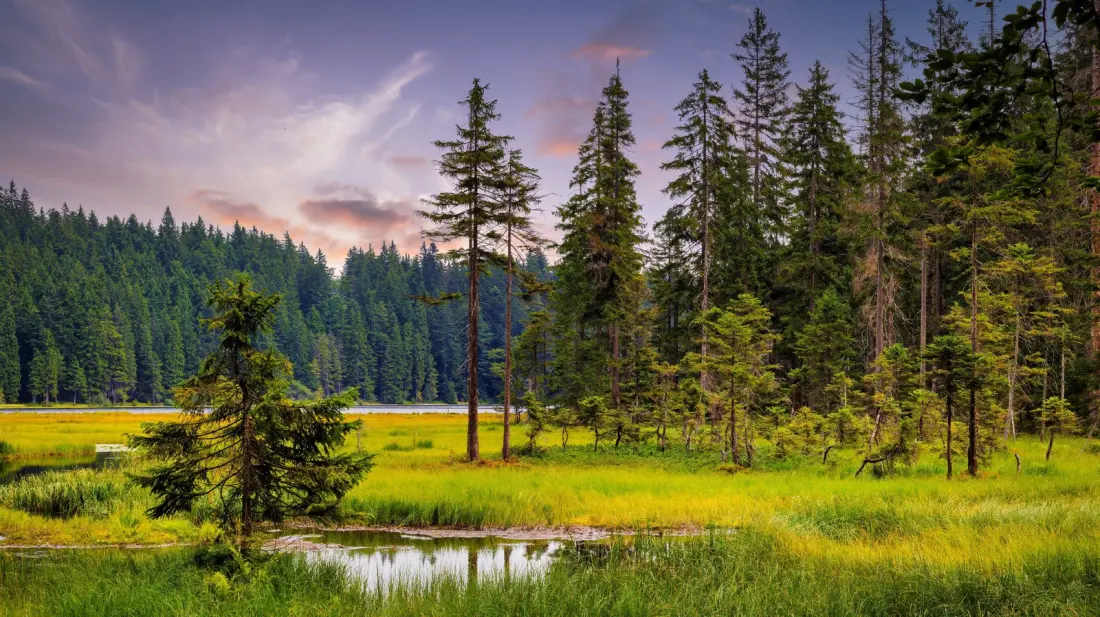
Munich gets the beer halls and the crowds, but two hours southeast lies a very different Bavaria. Bavarian Forest National Park — Bayerischer Wald to locals — runs along the Czech border and, together with Czechia's Šumava National Park, forms the largest protected contiguous forest in Central Europe. It's a landscape of beech and spruce, 57 named peaks, raised bogs and boulder fields, laced with more than 200 miles of marked trails.
The hiking here is the main draw, and it ranges from gentle to genuinely tough. The park's trail markers are colour-coded: animal symbols on yellow mean loop trails, plant symbols on white mean out-and-back routes. For a summit day, the Rachel Circular Route climbs Großer Rachel, the park's high point at 4,767 feet — expect around half a day, more than 1,800 feet of gain, plus a glacial lake, a wooden chapel, and big panoramic views at the top. The 9.3-mile Falkenstein Circular in the northwest is harder still, winding through primeval forest with nearly 2,500 feet of climbing. Serious trekkers can also tap into the northern stretch of the Goldsteig Trail, Germany's longest certified hiking route at 410 miles.
Wildlife is the other reason to come. Lynxes — Europe's largest wild cat — were hunted out of the region in the 19th century and reintroduced in the 1970s, though fewer than 30 now live here in the wild, so sightings are a lottery. Wolves and brown bears are present too, along with capercaillies, peregrine falcons, pygmy owls and three-toed woodpeckers. For a near-guaranteed look at rare species, the Lusen National Park Center maintains 200 hectares of open-air enclosures holding over 40 native animals — lynx, bison, moose, wolves, bears — reached by a 4.5-mile loop, with a spiral treetop tower that on clear days looks all the way to the Alps. Birders should aim for the Deer Antler Circuit for red deer, especially at rut season in autumn, or the Aberseewand reserve just outside the park for raptors and owls.
Winter flips the script: 50 miles of groomed cross-country ski trails take over, and the hiking network stays open to snowshoers, though not every path is cleared. Trail maps for both seasons are downloadable from the park's website, and most trailheads are reachable from car parks scattered around the park.
For travellers, this is a low-cost, high-reward alternative to the Alps — quiet, well-marked, and easily paired with a Munich city stay, with Austria's Karwendel Mountains only a four-hour drive if you want to keep walking. It suits hikers who want wild forest and real wilderness without alpine crowds.