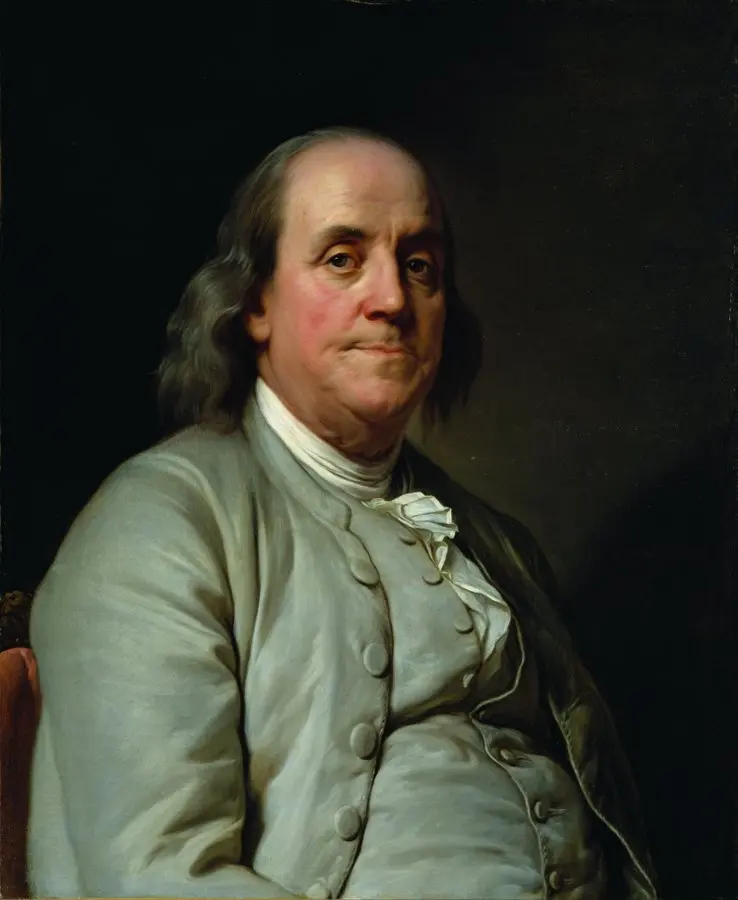
Before he was the face on the hundred-dollar bill, Benjamin Franklin spent nine years in Paris as America's man in France — and by most accounts, he loved every minute. The story of his French stint is part diplomacy, part celebrity culture, and it's surprisingly fun to trace through the city today.
Franklin arrived in the 1770s with a serious mission: persuade France to bankroll and arm the American Revolution. He turned out to be perfectly cast. Already famous as the scientist who tamed electricity with a kite, the philosopher-inventor with homemade bifocals became an instant hit in Parisian high society. His face turned up on snuffboxes, rings and medallions, and fashionable women took up 'la coiffure à la Franklin', styled after his rustic fur cap.
His base was a house in Passy, then a village suburb west of central Paris, complete with a lightning rod on the roof. It functioned as the unofficial American embassy, with philosophers, officers and academics flowing through until the early hours. Not everyone approved — fellow envoy John Adams recorded his disgust at how the French ladies queued to kiss Franklin, dismissing him as overly fond of female company. But the charm offensive worked. France recognised the United States in 1777 as the first country to do so, shipped tonnes of gunpowder and munitions across the Atlantic, and poured millions from the treasury into the American cause — money that nearly bankrupted the French government. Without Franklin's social networking, the revolution might have folded.
Even after signing the Treaty of Paris in 1783, Congress kept him in post, and the ageing diplomat kept busy: he watched the Montgolfier brothers' balloon take flight, played chess for hours at the Café de la Régence, and debated ideas at Le Procope, the oldest café in Paris. He even ran a small printing press at home, publishing his satirical Bagatelles. When he finally went home in 1785, the new US government gave him a cool reception — possibly thanks to Adams' gossip — but Franklin went on to govern Pennsylvania and sign the US Constitution, remembered ever after as the greatest president America never had.
Why should a traveller care? Because Franklin's Paris is still visitable. Passy remains an elegant corner of the 16th arrondissement, close to Trocadéro and the Eiffel Tower. Le Procope in the 6th arrondissement still serves dinner where Franklin once dined with Voltaire-era thinkers. And the Musée Carnavalet, Paris's history museum, holds plenty on the era. It's a different way into the city — less Versailles queue, more salon gossip and café philosophy — and a reminder that Franco-American history is written all over the Left Bank. History buffs, first-timers looking for a narrative thread through Paris, and anyone who likes their sightseeing with a side of scandal will get the most out of it.