In August 1415, King Henry V landed near Harfleur with around 12,000 men and a plan to take the French throne. What followed was a brutal four-month campaign that ended with the famous victory at Agincourt — and one writer decided the best way to understand it was to cycle the whole route through Normandy and the Somme to Pas-de-Calais.
The journey starts in unpromising fashion. The landing beach at Sainte-Adresse near Le Havre sits beside a city that was rebuilt after WWII in concrete by architect Auguste Perret. But Le Havre rewards the stop: it's a UNESCO World Heritage Site for its modernist design, and St Joseph's Church, with its abstract stained glass and towering lantern spire, is genuinely striking.
Harfleur itself resisted Henry for five weeks — far longer than he expected — before cannon finally breached the walls. The breach site is now an unglamorous roundabout locals call 'La Brèque', but the town still holds a vivid detail: after the surrender, Henry walked barefoot to the Church of St Martin to give thanks. Dysentery and battle losses had cut his army to about 8,500 men, so he abandoned plans to besiege Rouen and set off instead for English-held Calais, some 420 kilometres away through enemy territory in the October rain.
The route passes through Arques-la-Bataille, where Henry accepted bread and supplies in exchange for sparing the town — its huge castle, begun by William the Conqueror and later used to hold Joan of Arc before her transfer to Rouen, still dominates. Then comes the big logistical hurdle: crossing the Somme. For the modern cyclist this is the easy part, with a flat, shaded towpath along the Somme Canal now an official cycle route. The mood darkens near Péronne, where WWI cemeteries and battle sites line the way.
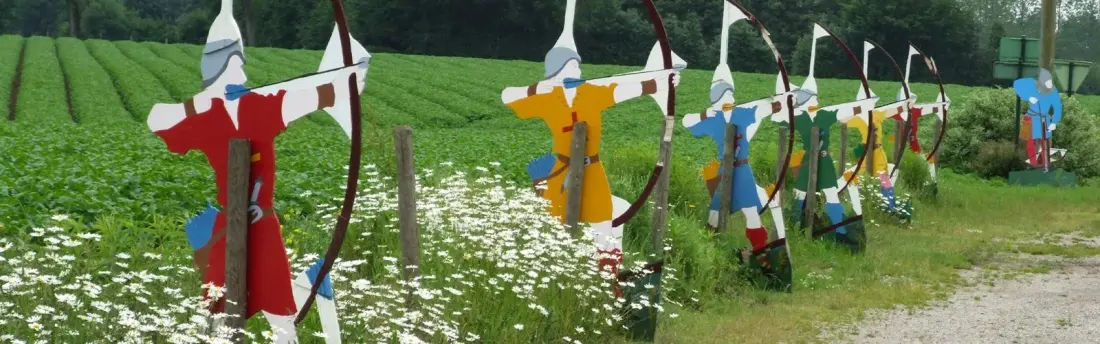
The payoff is Azincourt (an English knight's mispronunciation stuck), where on 25 October 1415 Henry's exhausted archers, dug in behind wooden spikes on dry high ground, destroyed a French force of 14,000–15,000 whose knights floundered knee-deep in mud after two weeks of rain. Around 6,000 French died, many of them nobles. Today the Azincourt 1415 museum lists some of their names on a commemorative wall, and a watchtower above the battlefield explains how the two armies were deployed.
For anyone who likes their history mixed with cycling, this is a superb route — a mix of medieval sites, a UNESCO city, easy canal paths and the challenge of Normandy's steep, beautiful river valleys. Budget roughly eight days to do it justice.