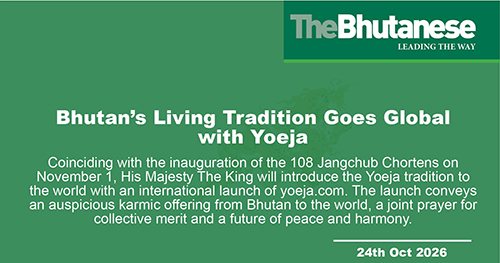
Bhutan has just given one of its oldest spiritual practices a digital home. On October 22, 2026, His Majesty The King became the first person to enter a digital prayer room at yoeja.com, reciting the six-syllable mantra Om Mani Padme Hung while a digital rosary — a chyem — rotated on screen with each touch. The platform logs every recitation, preserving an accurate count over a lifetime and pooling chants from users worldwide.
So what exactly is Yoeja? The word resists tidy translation. It is not charity or donation in the Western sense, but the offering of alms — money, goods or services — to monks, nuns, temples and spiritual practitioners, an act that generates merit not just for the giver but for all sentient beings. Bhutanese teachers describe it through tendrel, an auspicious connection binding those who pray, those who fund the prayers, and the subjects of the prayers. Generosity, in this framework, is measured by intention rather than size: a poor person's single flower can count as much as a wealthy patron's treasure.
The tradition runs deep. It arrived with the founding of Kyichu Lhakhang and Jambay Lhakhang, the country's oldest monasteries, in the seventh century. In the 1600s, Zhabdrung Ngawang Namgyel formalised it by establishing the Zhung Dratshang, the Central Monk Body charged with the nation's spiritual wellbeing. Bhutanese families have sustained these unbroken prayers for generations — a kind of 24/7 devotional hum under daily life.
The online launch is tied to something bigger. On November 1, 2026, construction begins on 108 Jangchub Chortens in Gelephu Mindfulness City, a Royal project billed as an offering of peace from Bhutan to the world. The international launch of yoeja.com coincides with that date, and anyone can register to add their recitations to a global tally of shared intention.
For travellers, this is a rare window into how Bhutan modernises without shedding its identity. Visitors to Bhutan often hear the mantra echoing across valleys; now they can join the practice from anywhere, or better, experience it in context — at Kyichu Lhakhang in Paro, at the monk bodies in Thimphu's fortresses, and soon amid the 108 new chortens in Gelephu in the country's south. If Gelephu Mindfulness City develops as planned, the November 1 milestone could mark the start of a whole new reason to visit southern Bhutan.
Whether the digital chyem can carry the weight of a 1,300-year-old tradition is a fair question. But Bhutan has form here — it famously filters tourism through Gross National Happiness rather than raw visitor numbers, and this launch feels cut from the same cloth: opening the door carefully, on its own terms. For travellers drawn to places where spirituality is lived rather than performed, Bhutan just added a new chapter worth watching — and possibly, a new date for the calendar.
Story via The Bhutanese