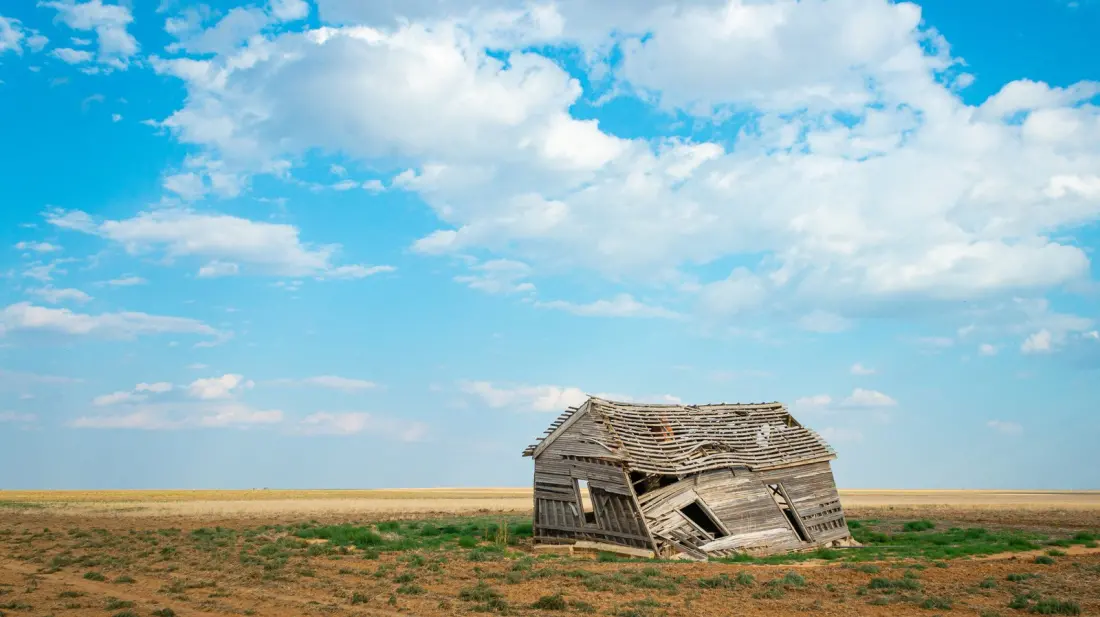
Oklahoma has more than 2,000 recorded ghost towns, a legacy of the oil, mining and cotton booms that briefly turned prairie stops into busy little cities — and then took them away again. Railroads closed, the Dust Bowl ruined the land, fires and floods finished the rest. A few of these places still cling on with a handful of residents, and they're among the most atmospheric stops you can add to a road trip through the state.
Texola sits right on the Oklahoma–Texas line along Route 66, and unlike most on this list it's a "living" ghost town with actual residents. It once ran a gristmill and two cotton gins before the Dust Bowl and Depression emptied it out. The Magnolia Service Station is listed on the National Register of Historic Places, making Texola an easy, photogenic pause on any Route 66 drive.
Fallis, founded in the 1890s in Lincoln County, was a cotton town with a notable Black community that included a newspaper editor in 1904 and several published authors and educators. The railroad's shutdown, Dust Bowl damage and a devastating fire in 1960 left little behind but crumbling structures.
Picher is the darkest entry: America's most toxic ghost town. From 1917 to 1947 it was a world leader in zinc and lead mining, but mountains of toxic waste contaminated the groundwater and destabilised the ground itself. Most residents left before an EF4 tornado struck in 2008, killing locals and flattening buildings. It's a sobering look at what industrial boom-and-bust really costs.
Skedee boomed on cotton and rail, then lost its train tracks to a 1957 flood and its post office by the early 1960s. A few people remain, commuting to nearby Pawnee for work and school. Centralia survived two major fires (1907 and 1917) and was thriving into the early 20th century — banks, hotels, a library, a newspaper — until the Great Depression gutted it and a planned railroad spur never materialised. Only a couple of decaying buildings survive.
Then there's Ingalls, founded in 1889 with no mine or railroad but plenty of outlaws. In September 1893, a gunfight between the Doolin-Dalton Gang and U.S. Marshals left nine people dead — genuine Wild West history that eventually drove families away, especially once the railroad bypassed the town.
Why bother? These towns compress a century of American boom, bust and Dust Bowl history into short detours, and several pair naturally with a Route 66 itinerary. They're best approached with respect: most are on private or semi-private land, structures are unstable, and in Picher's case contamination is a real hazard — look, don't climb. Photography buffs and history fans will get the most out of them, ideally in soft morning or evening light when the prairie does half the work. Source: Islands.