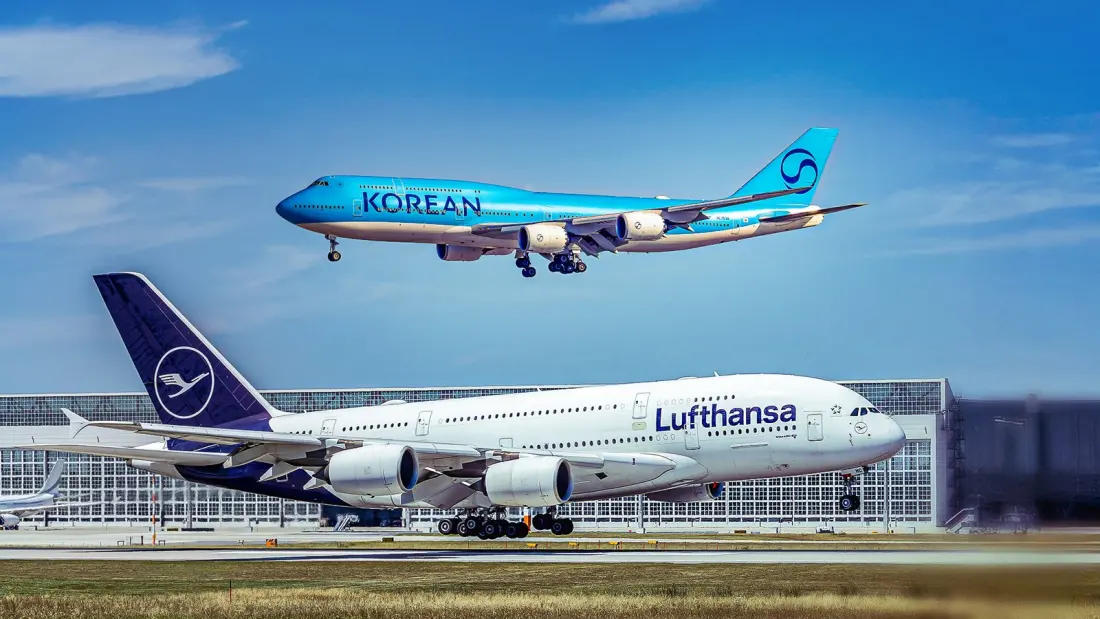
The Airbus A380 out-lifts, out-weighs and out-seats every other passenger jet ever built. But the Boeing 747-8 quietly kept two world titles of its own: it is the longest airliner in service and the fastest commercial jetliner flying today.
Boeing stretched the classic 7400-400 fuselage by 5.6 metres, adding sections fore and aft of the wings, to reach 76.25 metres nose-to-tail. That beats the A380 by roughly 11.5 feet and nudged past the previous record holder, the Airbus A340-600. Why stretch instead of widen? Gates. The A380's enormous wingspan forced airports to widen taxiways and install double-decker boarding bridges, while the 747-8's narrower 224-foot span lets it use standard widebody gates almost anywhere.
The speed crown comes from a 1960s gamble. Boeing engineers, expecting supersonic jets like Concorde to take over passenger travel, gave the 747 sharply swept wings built for pace. Paired with modern GEnx engines borrowed from the 787 programme, the 747-8 cruises at Mach 0.855, about 567 mph, just edging the A380, A350 and 787 at Mach 0.85. That sub-1% edge trims only minutes off a long flight, but dispatchers use it as schedule padding against headwinds and delays, useful on winter westbound routes where a few minutes can protect tight connections.
The programme was hardly smooth. Prototype wingtip vibrations forced structural reinforcements and control software rewrites, pushing deliveries back more than two years and adding over $2 billion in costs. The GEnx engines also missed fuel-burn targets by 2.7%, eroding the sales pitch against twinjets. Launch customer Cargolux famously walked out of its 2011 delivery ceremony until Boeing and GE offered discounts.
Airlines ended up using the two giants differently. Lufthansa, the only carrier flying both in numbers, bases its 17 747-8s in Frankfurt on routes like Newark, Tokyo and Johannesburg, and its eight A380s in Munich to Los Angeles and Delhi, where superjumbo-ready infrastructure exists. The economics stayed brutal either way: Boeing took about $4.2 billion in accounting losses on the 747-8 and delivered the last one to Atlas Air in January 2023, while Airbus spent over $30 billion on the A380 before closing the line in December 2021 after 251 deliveries.
The 747-8's length record has a countdown on it, though. Boeing's upcoming 777-9 measures 76.7 metres, 19 inches longer, and uses folding wingtips to fit the same gates. But for now, the four-engine era's final peak remains the fastest and longest airliner in the sky.
For travellers, the practical takeaway is simple: if you want to fly the Queen of the Skies in passenger form, Lufthansa's Frankfurt routes are your best bet, and the window is closing as fleets age. Story via Simple Flying.