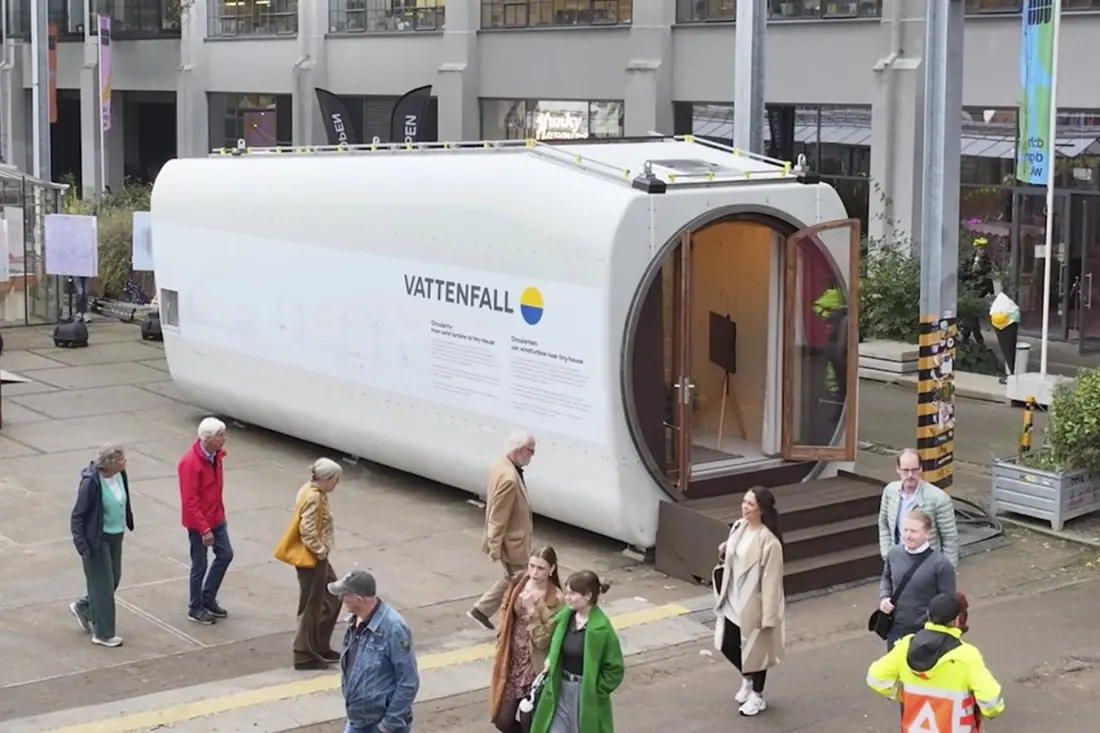
What do you do with a wind turbine when it stops making electricity? A Swedish-Dutch team has one answer: turn it into a house. A nacelle — the casing behind the rotor that houses a turbine's generator — that spent 20 years spinning 100 metres above an Austrian wind farm has been converted into a compact dwelling with a kitchen, bathroom, living area, solar panels, a heat pump and a solar water heater.
The turbine was a Vestas V80 2-megawatt machine installed at the Gols wind farm in Austria in 2005. Over two decades it generated 73 gigawatt-hours of electricity, which its owner, energy company Vattenfall, reckons matches the annual consumption of more than 29,000 households. Once the farm was decommissioned, Dutch firm Business in Wind made the nacelle available for reuse, and architecture studio Superuse kept the enclosure intact rather than breaking it down for materials, fitting out the interior for habitation. The project, named Nestle, was unveiled at Dutch Design Week in Eindhoven in October 2024, and it's been designed to meet building regulations for residential or holiday use — so a night inside a former turbine is a genuine possibility.
The bigger story here is waste. Around 90% of a wind turbine can already be recycled, but blades are the stubborn part: they're built from composites of fiberglass, carbon fiber, resin, wood and foam that are hard to separate. WindEurope projects 80 gigawatts of Europe's installed wind capacity will hit the end of its theoretical life by 2030, with annual volumes of decommissioned blade material climbing from roughly 20,000 to 55,000 metric tons. The industry has pledged a voluntary landfill ban on blades from January 1, 2026.
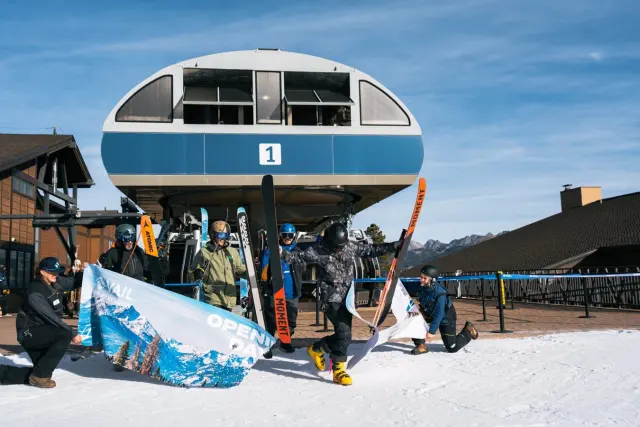
Creative reuse is filling the gap. In one project, Vattenfall teamed up with Norwegian recycler Gjenkraft and ski maker EVI to recover carbon fiber from blades at the Irene Vorrink wind farm in the Netherlands and work it into skis — Vattenfall ordered 15 pairs in March 2025. In Lund, southern Sweden, a new parking facility inaugurated in December 2025 has 57 retired rotor blades from a decommissioned Danish wind farm built into its facade as curtain walls.
For travellers, Nestle is the headline act: an offbeat stay that doubles as a lesson in circular design, exactly the kind of thing that fits a Netherlands trip built around Dutch Design Week or an architecture-themed detour in Austria. Even if you never sleep in a nacelle, the project signals where sustainable travel design is heading — industrial leftovers becoming accommodation, skis and building materials instead of landfill.
Story via Colombia One.