Brest doesn't look like the postcard Brittany of half-timbered houses — that's Quimper's job. The Finistère capital was flattened by Allied bombing in the Second World War, so what you get instead is a modern city with an unexpectedly rich mix: 17th-century fortifications, naval docks, street art, craft beer terraces and a surf-town streak. It sits at the mouth of the River Penfeld, guarding the Rade de Brest, one of Europe's great natural harbours and home to France's second-largest naval base after Toulon.
The city's centrepiece is the Château de Brest, a sprawling fortress above the Penfeld whose foundations include Roman walls. It flipped between France and England during the Hundred Years War, served the Dukes of Brittany, then got the full Vauban treatment when Brest became a naval port. Today it also holds the Musée National de la Marine, where the carved wooden ship figureheads by 18th-century local sculptor Yves Etienne Collet are a highlight. One quirk: photography pointing at the Maritime Prefecture buildings inside the walls is off-limits, which partly explains why the castle isn't all over Instagram.
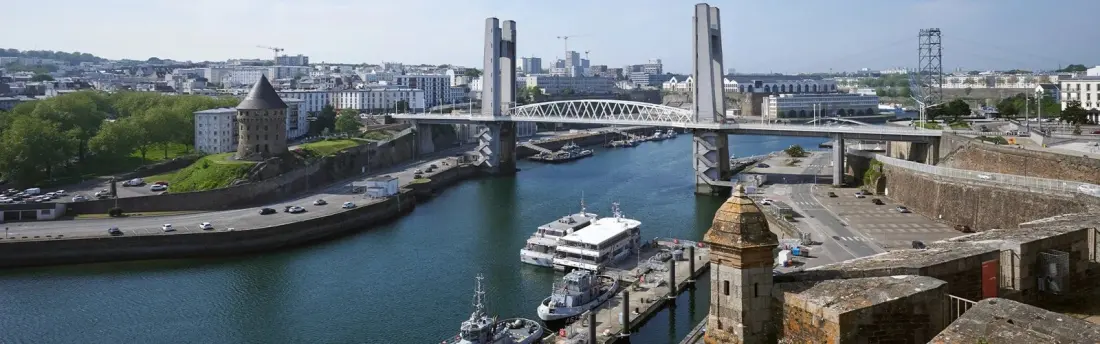
Brest's real icon, though, is the Pont de Recouvrance. Opened in 1954 as a statement of a city rising from wartime rubble, this vertical-lift bridge has 70-metre concrete pylons — the tallest lift bridge in Europe until Rouen's Pont Gustave-Flaubert came along in 2008. Its central span rises to let tall ships into the dry docks upstream. Locals liken it to a guillotine, and once you see it, you can't unsee it. At one end stands L'arbre Empathique, a 12-metre metal tree sculpture with live plants growing through its lattice; at the other, a sculpture of Fanny de Laninon and Jean Quéméneur from old sailor's songs, mid-tussle above the river.
Cross the river on the Téléphérique de Brest — France's first urban cable car when it opened in 2016 — to Les Ateliers des Capucins, a former convent turned naval workshop turned cultural hub with galleries, a cinema and a brilliant riverside terrace. Order street food at Fabrik 1801 and work through the Breton beer list; Duchesse Anne Triple is the one to hunt down. Nearby, Rue Saint-Malo is the city's surviving pre-war cobbled street, all artists' studios and stray cats.
For food, time your visit around the Sunday Marché Saint-Louis, where stalls ring the Église Saint-Louis — oysters and a glass of Muscadet at Coquillages Salomé is the move. Then, because Brest is a gateway to some serious coastline, catch the number 2 bus out to Plage de Sainte-Anne for a swim and walk a stretch of the Brittany Coast Path past forts and cliffs to the Petit Minou lighthouse, with a surfing beach curled below.
Getting there is easier than the far-west location suggests: four hours from Paris by train, 12km from Brest Bretagne Airport, or — the pleasant way — an overnight Brittany Ferries sailing to Saint-Malo and a train via Rennes. It draws far fewer crowds than Saint-Malo or Rennes, which is exactly the appeal.