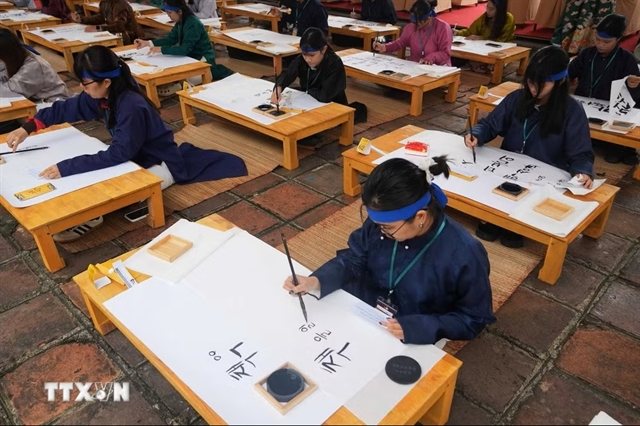
The Huế Imperial Citadel, once the seat of Vietnam's Nguyễn emperors, briefly turned Korean last week. On November 22, 80 contestants — school pupils, university students and hobbyists — sat down with brush and ink inside the former royal complex for a calligraphy competition written entirely in Hangeul, the Korean alphabet.
The timing was deliberate. The contest marked Hangeul Day (October 9, celebrating the alphabet's creation and proclamation), Việt Nam Cultural Heritage Day (November 23) and Việt Nam Culture Day (November 24). Organisers see it as more than a one-off: the Huế Monuments Conservation Centre wants it to become an annual fixture and, in time, a signature symbol of ties between Huế and the South Korean city of Boryeong, whose inkstones supplied the materials.
The artistic premise is a neat one. Both countries carry long royal calligraphy traditions — Vietnam's Nguyễn Dynasty (1802–1945) and Korea's Joseon Dynasty (1392–1910) — and contestants rendered Vietnamese royal poetry in Korean script, using ink ground on Nampo inkstones carved from rock quarried near Mount Seongju in Boryeong. Eleven prizes were awarded: a special prize, one gold, one silver, three bronze and five consolation awards.
If you're in Huế soon, you can still catch the results. The winning works are on display at Kiến Trung Palace inside the citadel until November 27. That palace itself is a reason to linger — rebuilt after near-total destruction, its Art Deco-meets-imperial interiors are among the citadel's most striking spaces.
The calligraphy contest sat within a wider culture programme. From November 21 to 23, the centre invited visitors to try traditional Vietnamese royal court games inside the citadel, an attempt to show how people at court once entertained themselves. The idea, according to organisers, is to pull heritage out of the display case and get people — particularly younger Vietnamese — physically engaging with it.
For travellers, this is a good reminder of how much Huế offers beyond the tombs and temples. The citadel is an active cultural venue, and November visits can coincide with heritage-day programming that costs little or nothing extra on top of your entry ticket. Korean culture has a growing footprint in central Vietnam, and Huế's ties with Boryeong add an unexpected layer to a city usually framed purely in Vietnamese imperial terms. If the competition returns annually as planned, a late-November trip might let you watch two calligraphy traditions share the same ink.