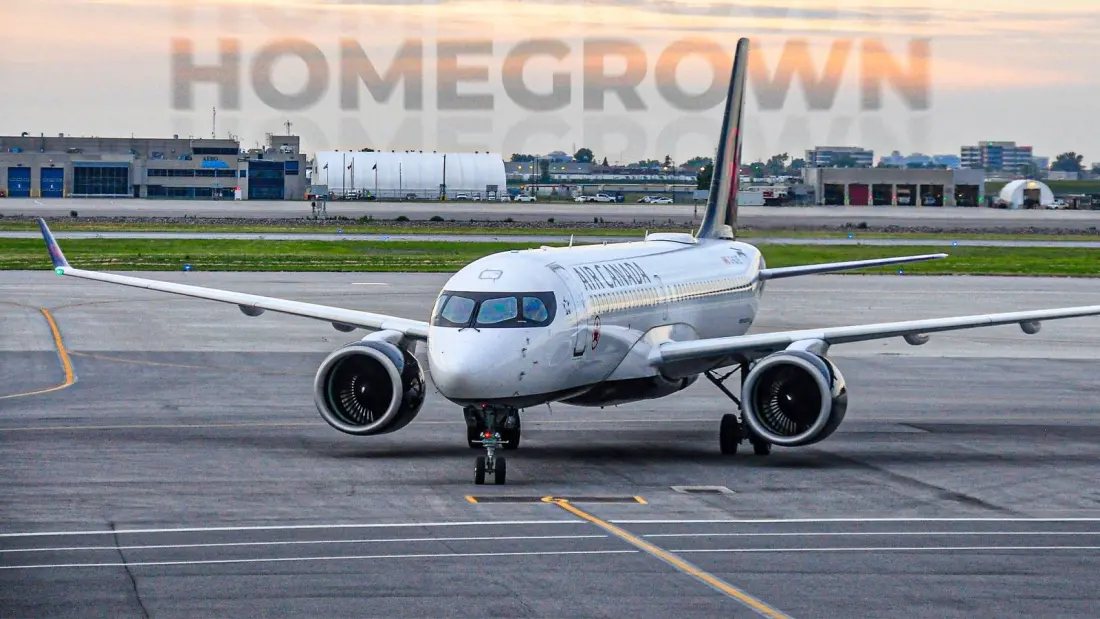
Air Canada's long-haul 777s and 787s get the glory, but the day-to-day schedule that gets Canadians between 50 domestic airports and dozens of US gateways runs on aircraft with Canadian engineering in their DNA. Three types do the heavy lifting — and travellers will soon feel the difference in the cabin, too.
The backbone of the mainline narrowbody fleet is the Airbus A220-300, the jet that began life as Bombardier's CSeries and is still assembled in Mirabel, Quebec. Air Canada flies roughly 45 of them with a firm commitment for 65 overall. Carrying 137 passengers (12 business, 125 economy) on fuel-sipping Pratt & Whitney geared turbofans, the A220 covers domestic trunk routes and transborder cities like Los Angeles, Denver and Seattle. New deliveries from March 2025 roll out the airline's updated cabin standard.
Below that, the Bombardier CRJ900 — around 29-30 airframes flown by Jazz Aviation as Air Canada Express — links smaller communities to the big hubs in a 76-seat two-class layout, with screen entertainment and Wi-Fi. It was built for exactly the short runways and regional economics of North American feeder flying.
Then there's the De Havilland Canada Dash 8-400, the 78-seat turboprop that makes downtown Toronto's Billy Bishop airport workable. Jets simply can't operate there under noise and runway restrictions, so the Dash 8's short-field performance is Air Canada's whole hand at YTZ — where it has launched daily US services to LaGuardia, Boston, Chicago O'Hare and Washington Dulles, going head-to-head with Porter Airlines in the financial district.
Passengers get a share of the good news: a 2025-2026 retrofit programme is bringing uniform comfort across the fleet. The headline change on the A220s is Airbus' XL overhead bins, boosting storage by 15% so roller bags fit on their side — a genuine fix for anyone fighting for bin space on Toronto-Montreal-Vancouver trunk routes. LED mood lighting and refreshed ceiling panels add a widebody-style feel to the single-aisle cabin.
Why should a traveller care? Fleet choice shapes your flight more than you'd think. Book a transborder or trunk route and you're likely on a quiet, modern A220; a regional hop puts you on a CRJ900 or Dash 8 with solid connectivity; a downtown Toronto departure means turboprops only. And while Air Canada still leans on non-Canadian metal for the long haul — 19 777-300ERs, 40 787s, 20 A330-300s, with 787-10s and A350-1000s due from 2030, plus lie-flat A321XLRs for the Atlantic — its homegrown narrowbodies and turboprops are what keep frequencies dense across North America. If you're planning a Canada trip with multiple stops, those frequent, right-sized connections are exactly what makes multi-city itineraries easy.