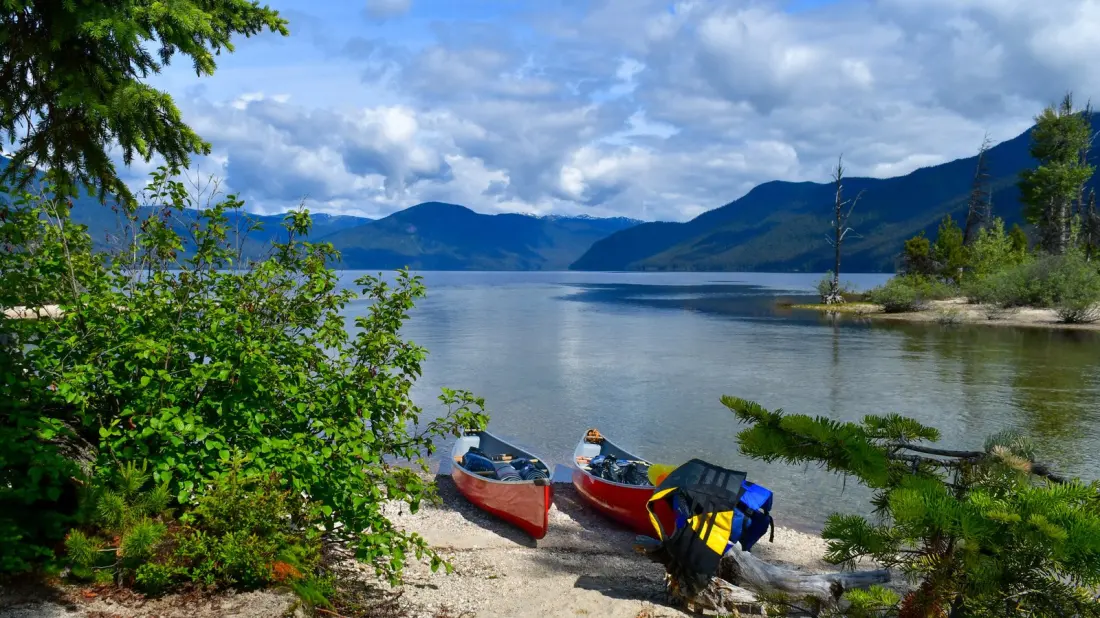
There are no motors allowed on Murtle Lake — and that's the whole point. At nearly 17,000 acres, this is North America's largest paddle-only lake, tucked deep inside Wells Gray Provincial Park in British Columbia, a park nicknamed Canada's Waterfall Park. If you want quiet water, forested mountain views and the feeling of being properly off-grid, this is a strong candidate.
Getting on the water takes commitment. From the parking lot, canoes and kayaks must be portaged 1.5 miles to the launch near Murtle Lagoon — bring wheels or a strong back. Once launched, you have a big main body plus two 12-mile arms to explore, lined with sandy beaches, trailheads and 20 wilderness campsites, all of which are reachable only by water. Even hikers have to paddle first.
The fishing is a major draw. Rainbow trout are the headline species, with trophy fish on the cards as well as steady action from smaller ones, and kokanee salmon add variety. Late spring through early autumn is prime time, and anyone 16 or older needs a BC freshwater fishing licence. A bonus option: Henrietta Lake, a short 0.6-mile hike from a trailhead on the southwest shore.
Hikers get real choices too. Five trailheads dot the 62-mile shoreline. The Anderson Lake and McDougall Falls trails are easy, roughly 1.5 hours each. The File Creek/McDougall Lake Route mixes portaging, paddling and hiking — though you can't continue past the portage, since the river rapids are too strong. From McDougall Lake another trail runs to Kostal Lake at the base of an extinct volcano. The tough one is the Wavy Alpine Trail on the eastern shore: three miles to Strait Lake, or a demanding six-mile climb to Wavy Crest Peak.
For waterfall fans, the Murtle River feeds the lake and carries more than half a dozen falls, including Helmcken Falls, Canada's fourth-highest.
Practicalities: the nearest village is Blue River, 16 miles east, and the closest big city is Kamloops, about 2.5 hours south, which also has the nearest commercial airport (YKA). One caution worth taking seriously — the lake can kick up rough chop, so check the weather forecast before any long crossing. There's no cell coverage or road access mid-trip, so plan food, safety gear and camp permits accordingly.
Who is this for? Self-sufficient paddlers, anglers chasing rainbows, and hikers who don't mind earning their alpine views. It's not a casual day-trip lake — the portage alone rules that out — but as a multi-day wilderness trip it's hard to beat in North America. Stock up in Kamloops or Blue River, book your campsite, and go in the summer window when trails are snow-free and the fishing is at its best.
Story via Islands.