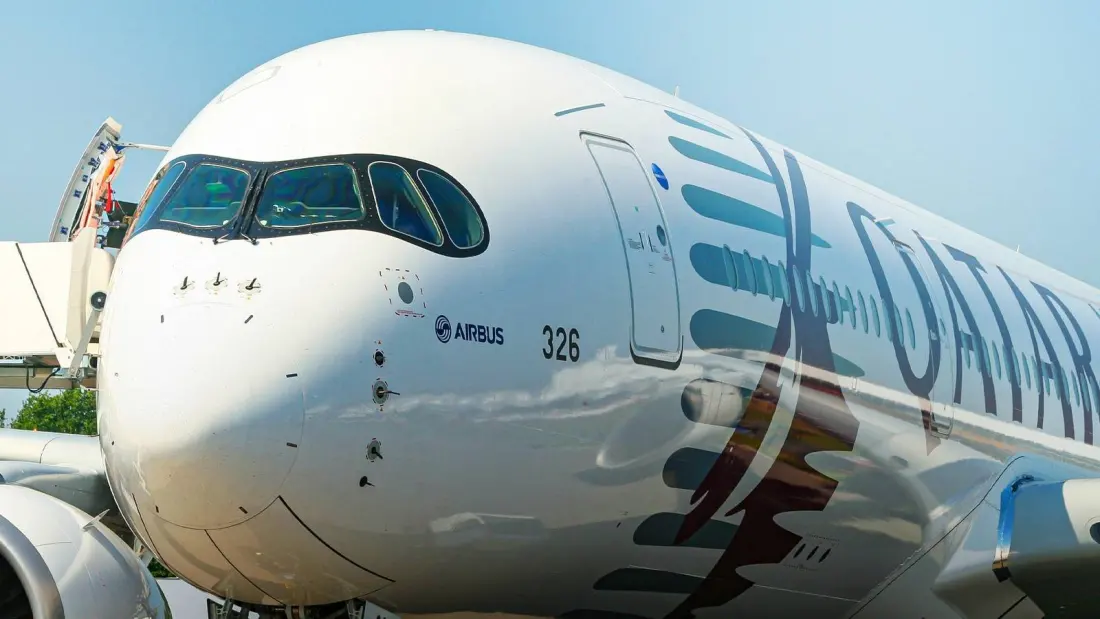
The Airbus A350 keeps topping passenger surveys for good reason: a composite fuselage, lower cabin altitude around 6,000 feet, better humidity, and Rolls-Royce Trent XWB engines that make flights quieter and smoother across routes of more than 8,000 nautical miles. Over 300 passengers can stretch out in its wider-than-usual cabin, and around 53% of the airframe is composite material. But one group has a more complicated relationship with the plane: the crews who have to sleep in it.
Long-haul and ultra-long-haul flights require augmented crews, and regulators like the FAA and EASA mandate proper in-flight rest areas — bunks that allow fully horizontal sleep, not just a reclining seat. Manufacturers build the structural space into the aircraft, but it's the airline that decides how to configure it, and that choice makes a huge difference in how rested crews actually feel after a 15-hour sector.
On most A350s, the pilots' rest area sits in the forward crown above the cabin with two bunks, while cabin crew get six bunks at the rear near the aft galley. This setup keeps the entire lower deck free for cargo — a big deal on long intercontinental routes where freight is a serious revenue stream. The catch? These overhead compartments are windowless loft-style spaces reached by a steep galley staircase. Crews report they can feel cramped thanks to fuselage curvature, suffer from cabin noise and vibration, and swing in temperature near the aircraft's upper skin insulation.
A small number of A350 operators go a different route: a lower-deck crew rest tucked beneath the passenger cabin near or within the cargo hold structure. It costs the airline cargo volume and adds certification complexity, which is why it's rare. But crews tend to prefer it — it's further from trolleys, galley clatter and passenger movement, better insulated, and thermally steadier. It feels like a genuine sleep module rather than a converted loft.
For comparison, the Boeing 777 is often praised for its 'train sleeper' layout — a long, linear aft crown compartment with eight to ten bunks of roughly two metres by 75cm, accessed via a staircase from the rear galley. Predictable, though sometimes noisy during meal services. The 787 takes an environmental approach: similar bunk sizes, but lower vibration, higher humidity and reduced noise mean crews often report better sleep quality even without extra space.
The takeaway for travellers is a fun one: two people flying the 'same' A350 can be on very different aircraft in practice. Comfort, for passengers and crew alike, isn't a fixed property of the airframe — it's the sum of hidden configuration decisions driven by airline economics, regulatory fatigue rules and manufacturing architecture. Next time you deplane feeling fresh after a long-haul on an A350, spare a thought for whoever slept the flight away in a windowless capsule above the galley — and hope their airline didn't sacrifice it for cargo space.