Chile's glaciers and deserts get the headlines, but the country's oldest story belongs to its Indigenous peoples — and increasingly, they're the ones guiding the experience. From Polynesia's most remote island to the world's driest desert, here's how community-led travel is opening up three very different Chiles.
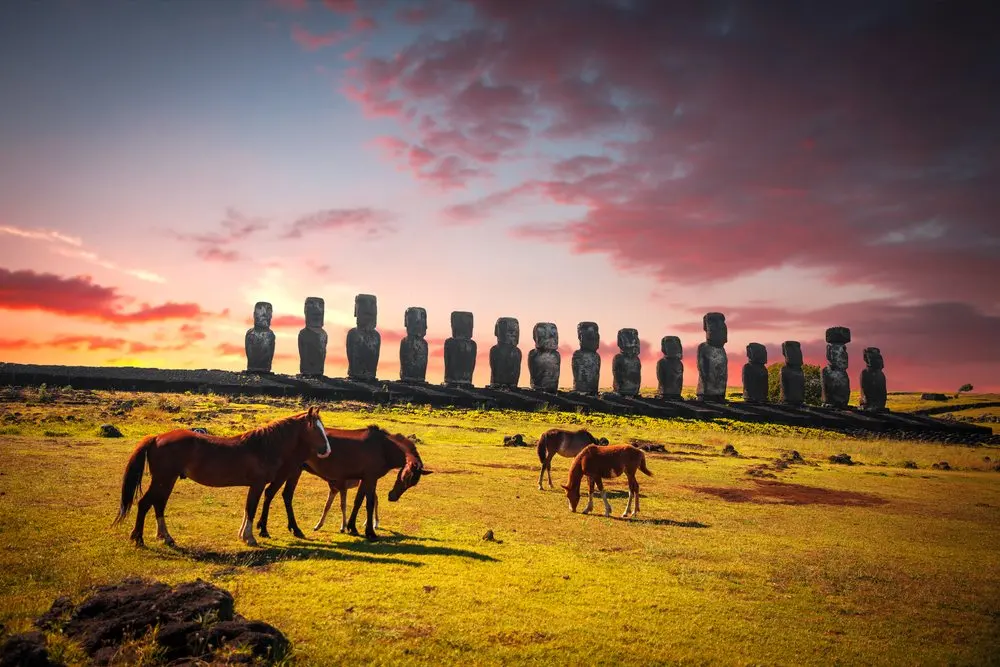
Start with Rapa Nui, the far-flung Pacific island better known for its Moai. Those towering stone figures aren't abstract monuments — they're carved portraits of real ancestors, and Rapanui guides can explain the oral histories behind them. At Rano Raraku, the volcanic quarry where the statues were shaped, you'll hear the local account of how multi-ton Moai were "walked" across the island. The culture is living, not frozen: families still cook umu, a feast of seafood and meat slow-roasted in an earth pit with hot stones and banana leaves, and Rapanui-run lodges now offer it to visitors alongside music and storytelling. For souvenirs with a direct line to the makers, skip the main market and head to Mana Gallery in Hanga Roa for wood carvings, jewellery and contemporary art. Time your trip for the Tapati Rapa Nui festival if you can.
Back on the mainland, the forested Araucanía region is Mapuche heartland — a people who resisted both the Inca Empire and Spanish colonisation, and whose worldview centres on Ñuke Mapu, Mother Earth. In the village of Llaguepulli you can sit around the hearth of a ruka, a traditional thatched oval dwelling, hear how Mapuche cosmology works, and even sleep in one. Practical skills come into play too: weaving on a witral loom with plant-dyed wool, and learning the medicinal herbs that machis (spiritual healers) still use today. Food is the hook for many — learn to make merquén, the smoky goat's-horn-chili seasoning that lands on nearly every plate, and try yiwin kofke, a deep-fried dough built for pebre salsa. Visit between February and April and you might catch piñones, the edible seeds of the sacred monkey puzzle tree.
The third thread runs through the Atacama, where the Lickanantay people have farmed and traded for centuries. Based in San Pedro de Atacama, you can visit the ayllus (oasis hamlets) around town, walk a llama caravan along old trade routes, and taste desert botanicals like chañar fruit and rica-rica — an aromatic shrub that turns up even in pisco sours. The Ayllu cooperative pours some of the world's highest-altitude wine, and with around three hundred cloudless nights a year, an Indigenous-led stargazing session is the natural finale: constellations once set the agricultural calendar here.
Why it matters: this is travel where the revenue and the narrative stay with the communities themselves, and where every region comes with its own food, craft and cosmology rather than a generic tour. If you want your Chile trip to have a point of view, plan it around the people who've known these places longest.