Most thru-hikers finish a trail and move on. This one kept coming back. The writer behind this piece has now completed five National Scenic Trails, but only after returning to fill gaps left by permit restrictions on the Continental Divide Trail and wildfire closures on the Pacific Crest and Pacific Northwest Trails. Their summer fix: two volunteer stints with the Pacific Northwest Trail Association (PNTA), bookending a 96-mile hike through Washington's North Cascades to close out the PNT for good.
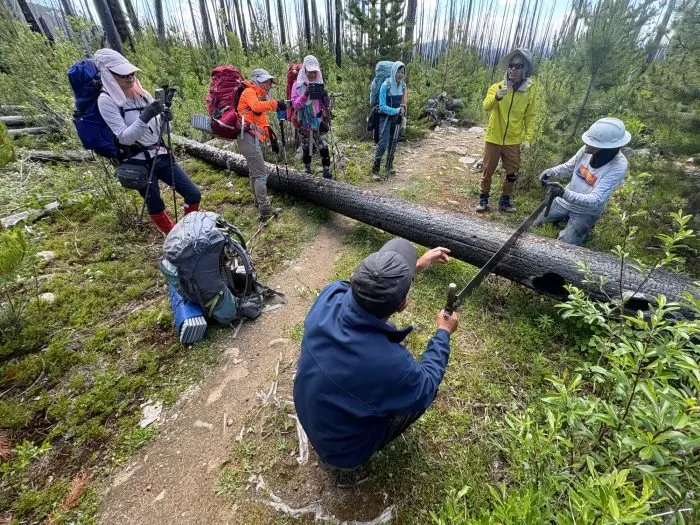
The first crew hitch began on July 1 at the ranger station in Tonasket, Washington. Working out of the Iron Gate Trailhead, the team set up basecamp near Louden Lake, less than a mile from the Canadian border, then spent days clearing drains and cutting through piles of fallen trees in the Pasayten Wilderness. For a long-distance hiker used to complaining about blowdown, the chance to actually remove it was satisfying, and crosscut saws drew crowds: passing backpackers offered M&M's (described as prime backcountry currency) and even asked for a turn with the saw, quickly discovering it's harder than it looks.
After the crew work, the author picked up a North Cascades National Park permit and hiked the missing stretch from Ross Dam Trailhead. It got rough fast. Around Whatcom Pass, a section burned by the 2022 Brush Creek fire and reopened in summer 2025 had essentially disappeared within a year, swallowed by waist-high brush and blowdown. The author logged a 13-hour day, legs shredded, before pink flagging tape signalled the way out. Days later, at Baker Lake Road, the PNT was finally complete.
A second PNTA project followed from Harts Pass, this one a stock-supported crew with US Forest Service packers running mules and horses, clearing logs along the Middle Fork Pasayten River. It ended early: lightning from a thunderstorm sparked a new fire about three miles from camp, and the crew was ordered to evacuate. It's a tidy illustration of the piece's broader point — a true, uninterrupted thru-hike gets less likely every year as trails burn, permits tighten, and maintenance backlogs grow.
For travellers, this is a good window into how America's long trails actually stay open: volunteer labour, small crews, crosscut saws, and a lot of mud. If you hike in the Pacific Northwest, you're almost certainly walking on someone's volunteer work. The PNTA runs crew projects open to newcomers, and trail towns like Tonasket, Omak and Concrete, Washington, anchor the route's quieter stretches.