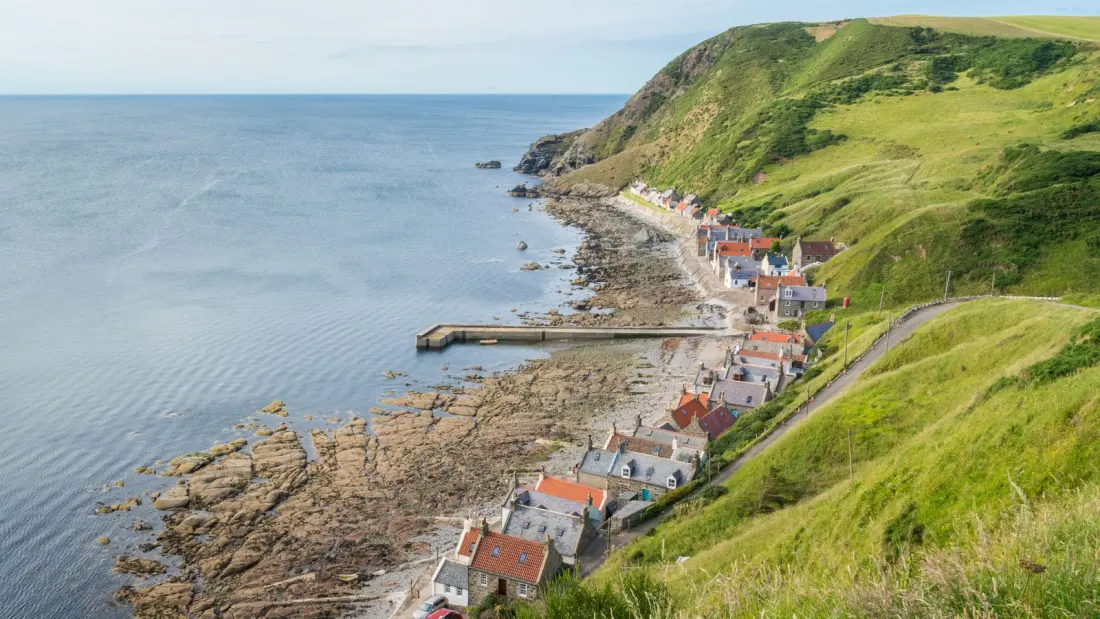
There are villages you drive through, and then there's Crovie — a settlement so cramped between cliff and sea that cars simply aren't allowed. This tiny former fishing village on Aberdeenshire's north coast sits on a narrow ledge of shoreline in Gamrie Bay, where a single row of roughly 60 cottages stands just a few feet from the water at high tide. The houses were built gable-end-on to the North Sea, a deliberate defence against storms, and the effect is unlike anywhere else in Britain.
The village owes its existence to hardship. Families cleared from inland farms during the 18th-century Highland Clearances turned to fishing here, and by 1900 around 50 boats were working out of Crovie and neighbouring Gardenstown. A brutal storm in 1953 wrecked much of the village and effectively ended life as a residential community — today most of the shorefront cottages operate as holiday rentals, which is partly why Crovie is among the best-preserved fishing villages in Scotland.
Getting there involves a commitment: you park at the top of the cliffs, which doubles as the best viewpoint over the village, then walk 15 steep minutes down. A smaller car park lower on the hairpin road fills quickly in summer. Once you're in, you wander a footpath running in front of the houses toward the far end of the bay — but time it for low tide, because waves regularly wash over the path at high tide.
There are no shops, cafés or toilets in Crovie itself. Most walkers head along the rocky shore to Gardenstown in the next bay, where you'll find public restrooms by the harbour, a couple of cafés, and The Garden Arms — a historic pub serving fish and chips and mac and cheese, with rooms if you want to stay over. A 2.75-mile circular route returns to Crovie via the clifftop path, so you don't have to double back.
The real draw beyond the village is wildlife. Nearby Troup Head is an RSPB reserve with 295-foot cliffs that host more than 50,000 seabirds each summer, including mainland Scotland's largest gannet colony, plus guillemots, kittiwakes and razorbills. Visit between May and July and you'll likely see puffins too. Dolphins, porpoises and even minke whales show up offshore, and the Moray Firth — reachable on boat trips from Lossiemouth, about 50 miles west — is home to the North Sea's only recorded group of bottlenose dolphins, along with seals and the occasional summer basking shark.
Crovie suits travellers who like their scenery wild and their villages quiet: hikers, photographers and anyone chasing seabirds. It's about 45 miles north of Aberdeen — roughly an hour and ten minutes by car — making it an easy day trip, though you'll need a vehicle. If you have spare time, the cathedral ruins and whisky distillery of Elgin are the same distance away.