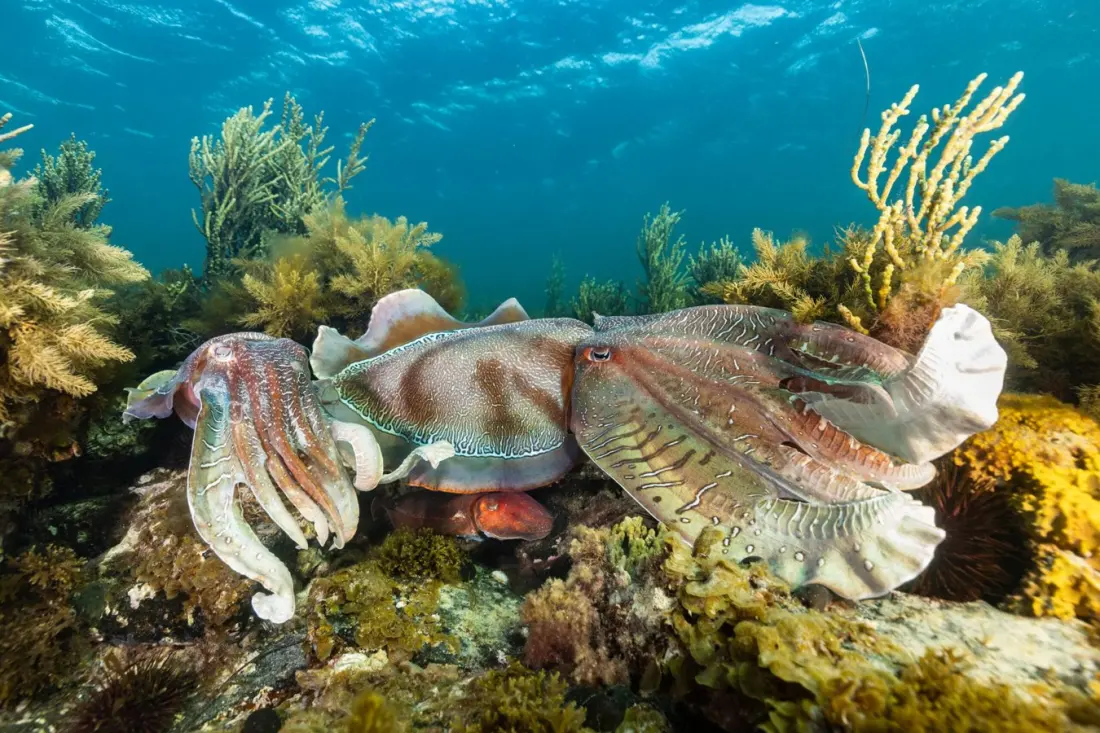
Every winter, divers slip into chilly water at Point Lowly near Whyalla to watch one of the ocean's strangest spectacles: thousands of giant Australian cuttlefish crammed onto a shallow rocky reef, males wrestling for mates while their skin flashes purple, gold and white. It is the only mass breeding aggregation of its kind on the planet, and right now it is in serious trouble.
Surveys by the South Australian Research and Development Institute, which have tracked the population since 1998, estimated more than 247,000 cuttlefish in 2020. By 2025 the number was around 64,000. This winter, the state government reported a record low of just 1,811 — even using an expanded method that counted animals hiding under rocks. Researchers suspect a massive harmful algal bloom that has spread through South Australian waters for over a year is a likely contributor, though the investigation continues.
The bloom story could have been worse. As it approached the Cuttlefish Coast in winter 2025, governments installed a bubble curtain around part of the breeding reef as an emergency barrier. It was never switched on — the bloom didn't arrive in time to hit the eggs, and most hatched by early October. But when winter returned, the adults largely didn't.
There is a genuine counterargument: cuttlefish populations are famously volatile. They live fast, breed once and die, and this same population crashed to roughly 13,500 in 2013 before bouncing back above 100,000 within two years. But a rebound needs enough adults to return and lay eggs, and this year the reef's rocks stayed nearly bare. In July 2026, authorities imposed a 90-day restriction on swimming, snorkelling, diving and anchoring along part of the coast to protect breeding animals and eggs.
The cuttlefish are just the countable part of a much bigger loss. Divers along Edithburgh Jetty, Port Hughes, Port Victoria, Gulf St Vincent, Spencer Gulf and Kangaroo Island report sponges, sea squirts and bryozoans — the colourful fixed life that makes temperate reefs feel dense and alive — collapsing or vanishing across wide areas. Even the crackle of snapping shrimp has gone quiet at some sites.
The bigger issue, argues marine biologist Stefan Andrews of the Great Southern Reef Foundation, is that almost nobody is measuring this. The Great Southern Reef runs about 8,000km from Kalbarri in Western Australia around the southern coast and Tasmania to the NSW–Queensland border — a kelp-covered rocky reef system supporting thousands of species found nowhere else, plus fisheries and tourism in dozens of coastal towns. Yet while the Great Barrier Reef has four decades of monitoring behind it, its larger southern counterpart relies on scientists scraping by on short grants. Southern Australian seas are warming faster than the global average, and marine heatwaves once considered rare are now routine.
For travellers, this matters twice over. The Whyalla cuttlefish aggregation has long been one of Australia's most accessible wildlife dives — you can snorkel it from shore — and the current access restrictions show how fragile it has become. If you go in a good year, follow local rules, keep your distance and treat it as the rare event it is.