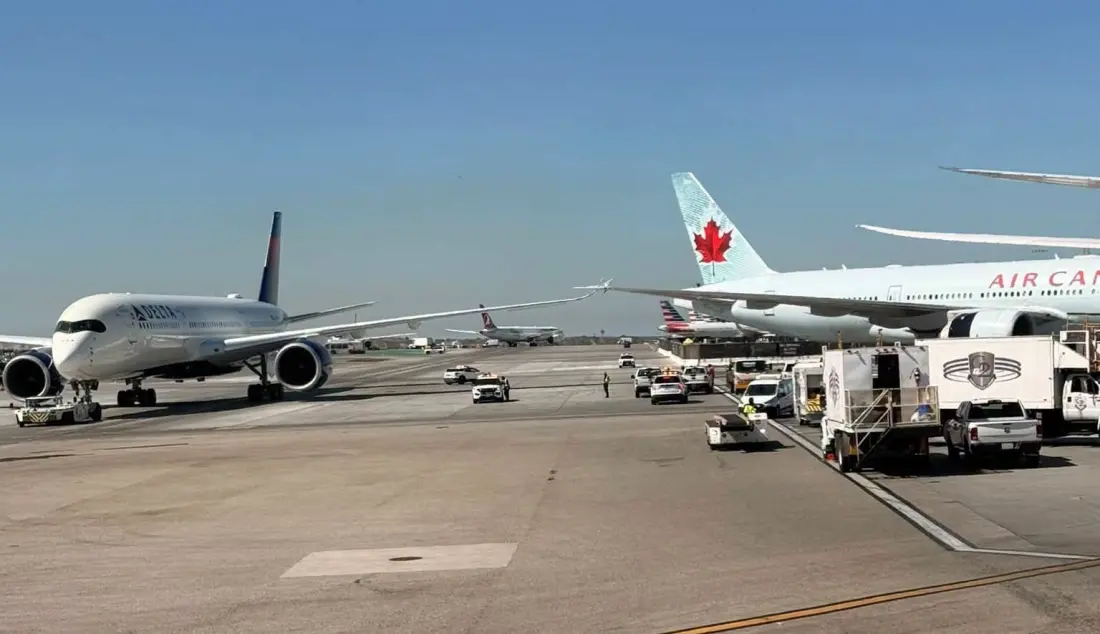
Two widebody jets made contact on the ground at Los Angeles International Airport on the morning of October 6, 2026, when a Delta Air Lines Airbus A350-900 struck the tail of an Air Canada Boeing 777-200 while taxiing for departure. Nobody was hurt, but both aircraft were damaged and hundreds of passengers saw their plans upended.
The details, per the Federal Aviation Administration: Delta flight DL7 was taxiing out for its scheduled service to Tokyo Haneda when its left wingtip hit the horizontal stabilizer — the small wing-like surface at the tail — of Air Canada flight AC785 around 10:30 am. The Air Canada jet, registered C-FIVK, had just arrived from Toronto and was being towed to its gate when the collision happened. Notably, it had stopped short of the gate, so Delta did not simply clip a parked plane. Why the tow halted, whether the 777's tail extended into a taxi route, and what clearances were given are all questions the FAA investigation will need to answer. It is too early to assign blame.
Both airlines confirmed the contact. Air Canada said no passengers or crew were injured and pulled the aircraft from service for inspection and repairs — a knock-on cancellation of the return flight AC786 to Toronto left travellers stranded. Delta apologised for the disruption; its A350 (N512DN) had not departed LAX as of reporting, though DL7 had not been officially cancelled.
For travellers, the practical takeaway is less about the drama and more about what ground incidents mean for your itinerary. A damaged widebody can take an aircraft out of service for days, and on thin long-haul routes there is rarely a spare plane sitting around. If you are booked on a long-haul flight out of a busy hub like LAX, a morning ground incident can cascade into same-day cancellations, so it pays to know your rebooking rights and to have the airline's app notifications switched on. Travel insurance that covers delay and cancellation expenses is also worth considering on big-ticket long-haul trips.
The investigation will look at ramp control procedures, tug operations and taxi clearances — the unglamorous choreography that usually works smoothly at one of the world's busiest airports. For now, the good news is straightforward: everyone walked away, and the incident was contained to the tarmac rather than the air.