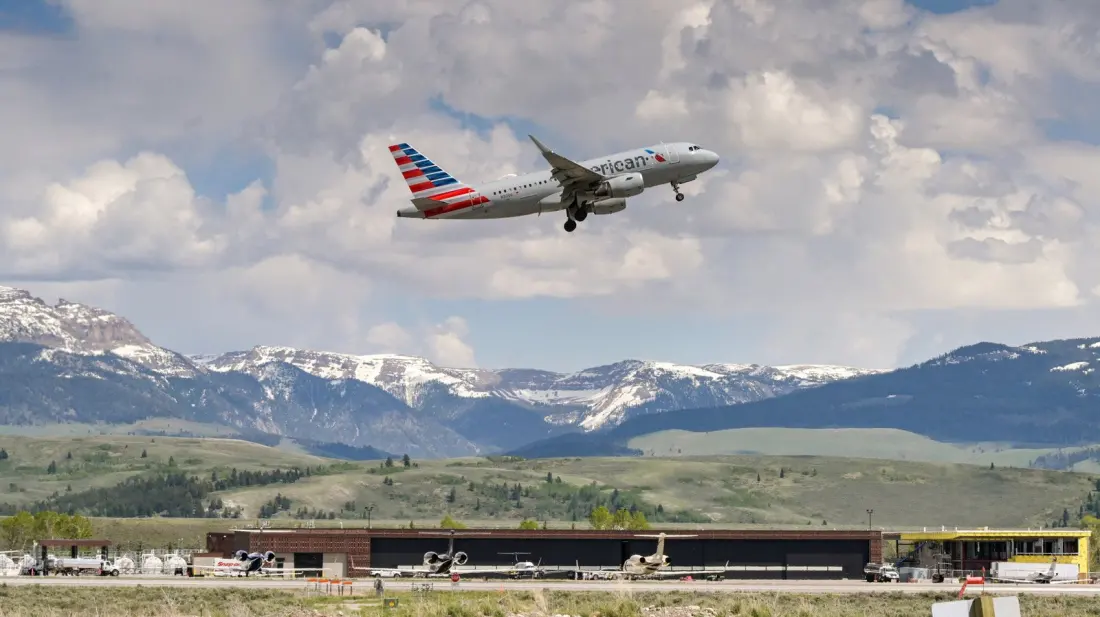
The shortest hop on your itinerary could be the roughest. Aviation analytics firm Turbli crunched turbulence data for 2025 across 10,000 routes serving 550 major airports, and the bumpiest route in North America turned out to be the 1.7-hour flight between Denver, Colorado and Jackson, Wyoming. It scored an eddy dissipation rate (EDR) of 18.18 — the standard measure of turbulence intensity, where higher numbers mean rougher air.
There's a clear pattern behind the ranking. Every route in the North American top 10 crosses the Rocky Mountains, and the world's most turbulent route — Mendoza, Argentina to Santiago, Chile, at an EDR near 23 — flies over the Andes. Mountains churn up the atmosphere: wind hitting a tall range creates waves and updrafts that a plane passes through as shaking. Thunderstorms add to the chaos, and their effects can travel hundreds or thousands of miles, producing clear-air turbulence that arrives with no visible warning. Jet streams do the same.
Before you reroute your ski trip, some perspective. Less than 5% of the atmosphere at cruising altitude has turbulence at any moment, and nearly all of it is light. Veteran commercial pilot Chris McGee told Sky News that a plane crashing from turbulence is about as likely as "a meteorite landing on my head" — modern aircraft are, in his words, way overbuilt. The real risk is inside the cabin: unsecured passengers, loose bags, and hot drinks becoming projectiles.
That's where smart habits come in. Book an early-morning flight if you can — afternoon heating creates thermal updrafts that make for choppier air. Pick a seat toward the front of the plane near the centre of gravity, where rocking is least pronounced. Keep your seatbelt fastened even when the sign is off, and if severe turbulence hits while you're in the lavatory, stay put and brace yourself rather than trying to walk back down the aisle.
For travellers, the takeaway isn't to avoid Denver–Jackson — it's a popular and scenic gateway to Grand Teton and Yellowstone country — but to fly it prepared. Rough air on mountain routes is normal, manageable, and rarely more than a bumpy inconvenience when you're belted in.