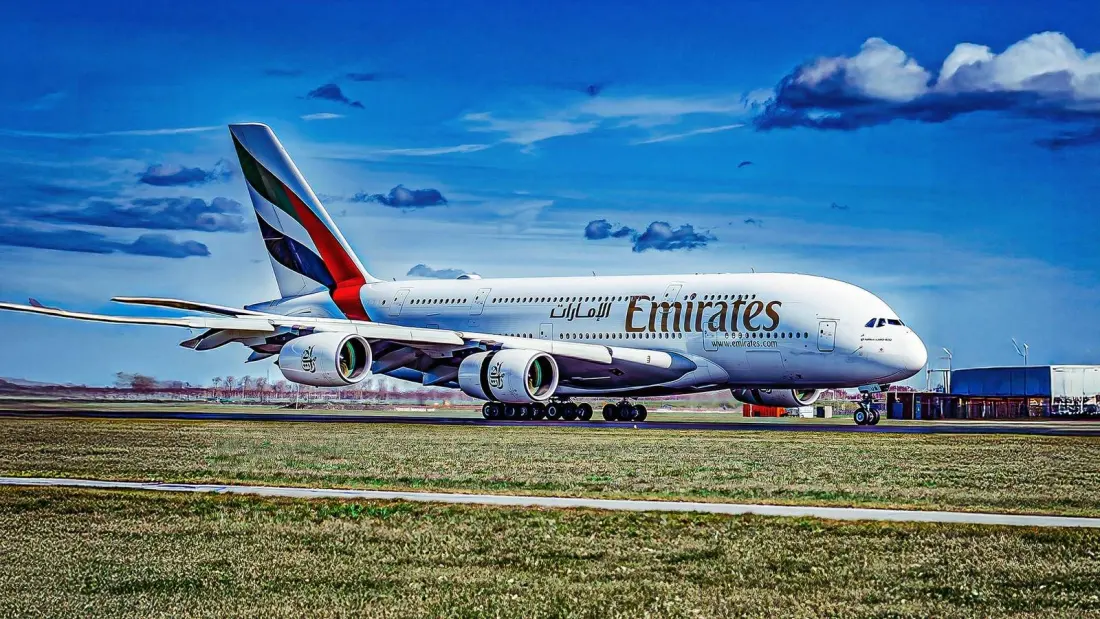
Houston has its superjumbo back. On November 1, Emirates once again began flying the Airbus A380 between Dubai International (DXB) and Houston George Bush Intercontinental (IAH), restoring the double-decker to one of the longest routes in its network — a block time of 17 hours westbound and just under 15 hours on the return.
The return caps a bumpy few years for the route. Emirates first flew to Houston in December 2007 with the Boeing 777-200LR, upgraded to the larger 777-300ER in 2012, and brought in the A380 in December 2014. The superjumbo served the city daily until early 2020, came back in December 2022, then paused again in February 2026 when airspace closures tied to the war in Iran forced a temporary suspension. Service resumed in May 2026, but by August Emirates had swapped in the smaller 276-seat 777-200LR — a move that trimmed capacity by 43% and, notably, removed first class entirely.
Now the A380 is back on a daily rotation with 484 seats across four cabins: 14 first class suites, 76 business seats, 56 premium economy seats in a 2-4-2 layout with 40 inches of pitch, and 338 economy seats at 32 inches in a 3-3-3 configuration. The premium economy cabin is a genuine draw for Texas-bound travellers — the 777-200LR that flew the route until October 31 had none.
The official flight EK211 departs Dubai at 9:40 AM and lands in Houston at 4:40 PM local time. The great-circle distance is 7,098 nautical miles, though avoiding Iranian, Ukrainian and Russian airspace stretches the actual routing to around 7,211 nautical miles — a negligible penalty given the circumstances.
Why does Houston matter so much to Emirates? US Department of Transportation data shows more than 3.5 million round-trip passengers have flown the route since it launched, with 249,000 in the 12 months to February. Booking patterns reveal the route's real function: roughly 70% of passengers are connecting through Dubai, with India dominating the traffic — Mumbai, Hyderabad, Bengaluru, Delhi, Ahmedabad and Kochi all feature in the top ten city pairs. Karachi, Manila and Dammam round out a picture of a route serving huge South Asian diaspora and energy-sector demand rather than point-to-point Texas traffic.
For travellers, the practical upshot is simple: if you're flying between the US Gulf Coast and South Asia or beyond via Dubai, you once again get the full A380 experience on this route — including first class and premium economy, plus the quieter, roomier ride the double-decker is known for on ultra-long sectors. Just be aware that equipment swaps have happened before on this route, so it's worth confirming the aircraft type when booking if the cabin matters to you. News via Simple Flying.