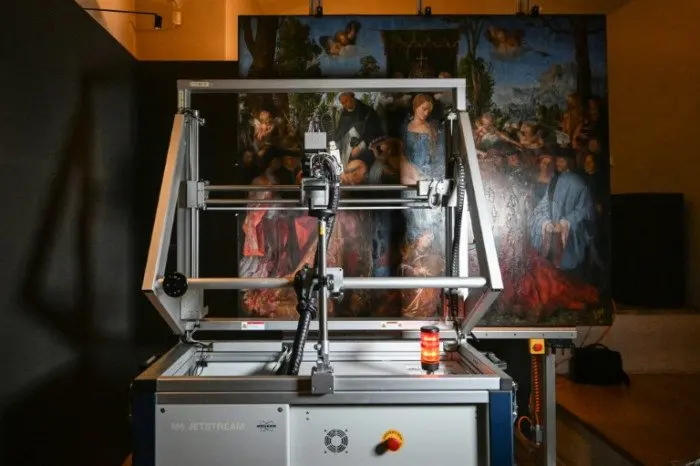
One of Prague's most treasured paintings is about to disappear from view for years. Albrecht Duerer's "Feast of the Rosary", a Renaissance altarpiece in the National Gallery, is starting a five-year conservation project that curators expect to finish in 2031.
The painting has led a rough life. Duerer created it in 1506 for the church of San Bartolomeo in Venice, painting in oil on poplar wood in the Venetian manner. It shows the Virgin Mary and infant Jesus distributing rose garlands to a crowd of figures that includes the future Emperor Maximilian I and Pope Julius II. The work was celebrated in its day, drawing German worshippers in Venice in droves, but the fragile wood panel did not cope well with centuries of handling.
In 1606, Holy Roman Emperor Rudolph II bought the painting and had it carried overland to Prague, where it eventually slipped into obscurity as his collection was scattered. It dodged looting Swedish troops during the Thirty Years' War, yet an 18th-century inventory still described it as completely destroyed. Czech painter Johann Gruss attempted a major overhaul in 1839-1841, and that intervention is now part of the problem: paint is flaking off along the seam between Duerer's original work and Gruss's retouching, millimetre by millimetre.
The restoration itself will be high-tech. Chief restorer Adam Pokorny's team plans macro-XRF scanning, the same technique the Rijksmuseum is using on Rembrandt's "The Night Watch", to map the pigments and reveal fine details, plus a 3D model of the panel to assess the damaged wooden base. Only an estimated 75-80 percent of what visitors see today is actually Duerer's hand; restorers will stabilise the original paint, strip away low-quality later additions and repair the support, all under the eye of an international committee.
The painting has a quirky loss, too: a fly Duerer once painted on Mary's knee has vanished, and its exact appearance remains disputed. The Czech state paid 9.6 million koruna for the work in 1934, then a national record for an art purchase, after the Strahov monastery turned down bigger foreign offers. It spent the Second World War tucked away in shelters.
Why should travellers care? The work is a fixture of the Convent of St Agnes of Bohemia, the National Gallery's branch for medieval and Renaissance art in Prague's old town. While it is off display over the next five years, the project itself may become part of the story, in the way the Rijksmuseum turned the public restoration of the Night Watch into a visitor attraction. Either way, art lovers heading to Prague should check the gallery's programme before going, and use the downtime to explore the rest of the city's staggering collection of Bohemian Gothic and Renaissance painting.
Details via Bangkok Post Life.