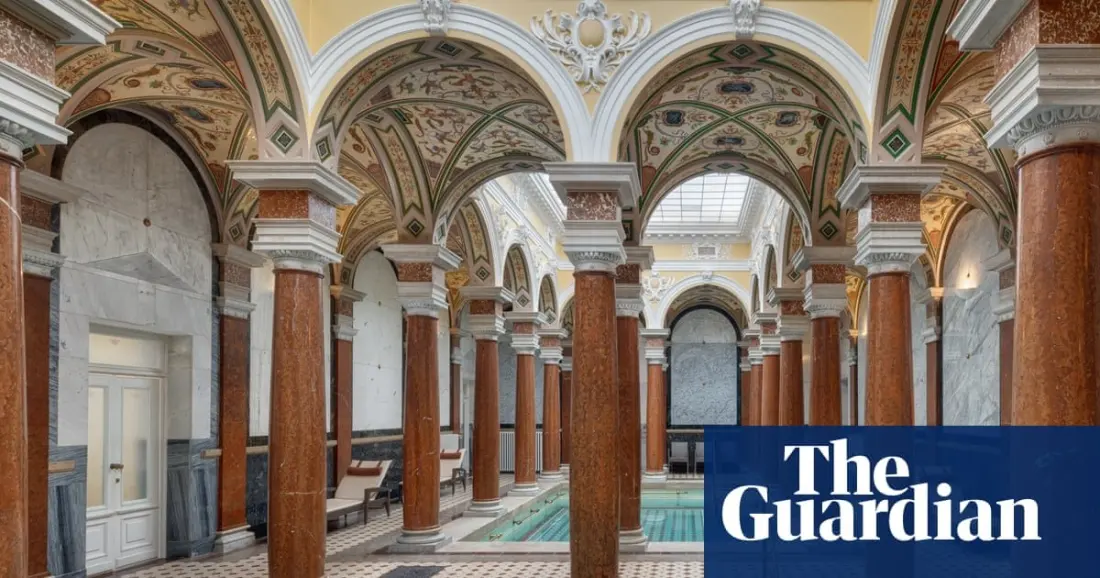
Wellness tourism didn't start with yoga retreats and cold plunges — it started in Europe's spa towns, where aristocrats, writers and convalescents spent centuries 'taking the waters'. In 2021, Unesco recognised 11 of them as a single transnational World Heritage site, including Bath, Spa in Belgium, and the west Bohemia trio of Karlovy Vary, Františkovy Lázně and Mariánské Lázně. Autumn, when the crowds thin and the forests turn, is a fine time to see what the fuss was about.
Mariánské Lázně might be the prettiest of the Bohemian three, with colonnades where visitors still drink mineral water from porcelain cups. The Nové Lázně hotel (doubles from €234 B&B) has a spa with marble-columned baths and a treatment cabin built for King Edward VII, who visited nine times. Pair the waters with a crispy spa wafer — nobody said this was all virtuous.
In Bavaria, Bad Kissingen is one of Germany's roughly 350 spa towns, and arguably its most architecturally interesting, with Max Littmann's stained-glass fountain hall and the vast Wandelhalle, where a spa philharmonic plays several times a day — the town holds a world record of 727 concerts in a single year. Entry-level soaking starts at the KissSalis Therme (from €19 for two hours), while the Grand Hotel Kaiserhof Victoria (from €209) even has an inhalation room built around a salt-encrusted graduation tower.
Bad Wildbad, in the Black Forest, adds adrenaline to the balneotherapy: a funicular up the Sommerberg, a 40-metre treetop tower with a slide, and the 380-metre Wildline suspension bridge over the Enz valley. Two thermal baths await back in town, including the statue-flanked Palais Thermal (€21 for three hours).
There's a spa town for almost every taste. Bagnoles-de-l'Orne in Normandy pairs belle époque villas and mushroom foraging with a fond legend about a warhorse healed by sulphurous waters — and it's under 90 minutes from the Caen ferry. Bad Gastein in Austria has a waterfall running through town and radon-rich thermal springs; the new Cōmodo hotel (from €188) is a refashioned 1960s sanatorium. Piešťany in Slovakia is famous for its near-boiling blue-black mud, applied at 45°C and hosed off ten minutes later. Rogaška Slatina in Slovenia lets you taste magnesium-rich Donat Mg free from the source, then tour the crystal factory it inspired. Salsomaggiore Terme in Emilia-Romagna combines the gilded art nouveau Terme Berzieri (sessions from €62) with parmigiano tours and Verdi opera. And in Portugal's Algarve hills, Caldas de Monchique trades beach crowds for cork forests and warm alkaline springs.
Why go now? These towns were built for shoulder-season rest: mild weather, walking trails, concert halls and thermal pools made for lingering. Prices for heritage hotels often start under €200 a night with spa access — better value than most modern wellness resorts, and with considerably more history.