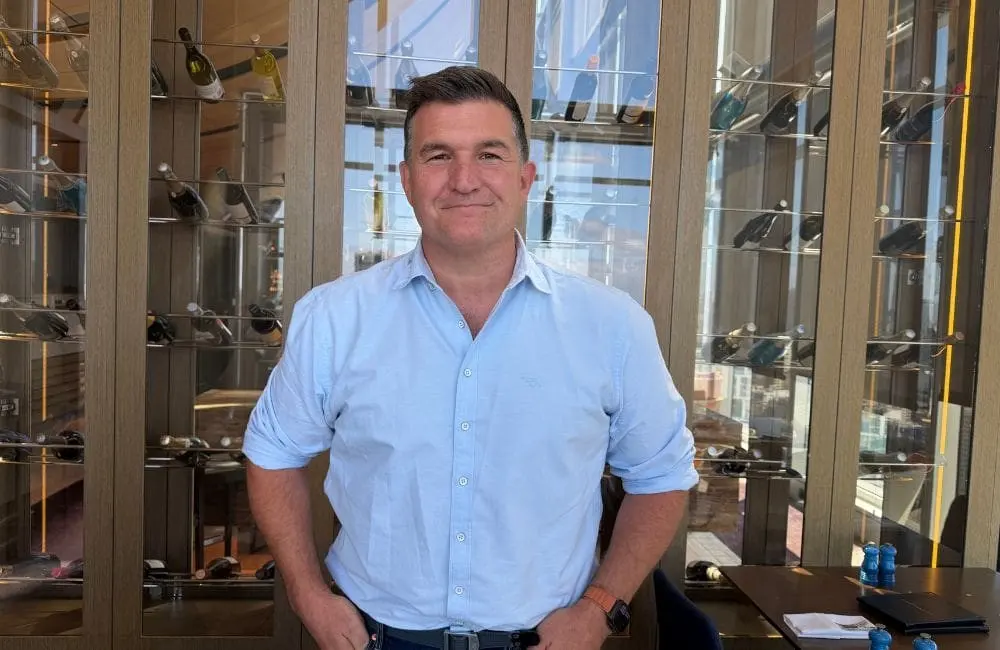
Quark Expeditions President Sam Seward was in Sydney recently for CLIA's Cruise360 conference, and what he had to say paints a picture of a polar operator in serious growth mode — with knock-on effects for anyone dreaming of Antarctica or the Arctic.
The headline news is a partnership with APT. The two companies are building a 99-suite vessel, owned by APT and chartered by Quark on a 10-year deal, that will sail Antarctica for Quark and the Mediterranean for APT's Travelmarvel brand from 2029. Despite capacity for 180 guests, Quark plans to cap it around 160 to preserve its one-expert-to-six-guests ratio. The ship will carry Ice Class PC6 certification and forward-facing sonar, with Quark closely involved in designing passenger flow and common spaces as a working expedition platform, while APT handles the comfort, aesthetics and food-and-beverage side.
That new build sits alongside fleet growth driven by demand. Quark currently runs three ships, all under six years old: Ultramarine, its custom-built 2021 flagship with two twin-engine helicopters; the 138-guest Ocean Explorer with its distinctive Ulstein X-Bow; and World Voyager, which starts Antarctic seasons in November 2026. A fourth ship is being scoped for 2029-2030. Seward also flagged that newer ships have cut emissions per passenger by roughly a third since 2019 — one reason Quark won't just add an older vessel to fill berths.
The Asia Pacific market is a big part of this expansion, growing 22 per cent year on year, with nearly a quarter of Quark's global passengers now coming from the region. Australians are booking earlier and splurging on premium suites, and the demographic is shifting: polar travel is no longer just for milestone birthdays and retirements, but drawing active travellers who'd otherwise choose wildlife or safari trips. The repeat business stat is striking — eight in ten guests who do Antarctica with Quark go on to rebook an Arctic voyage, whether that's Greenland, Svalbard, the Northwest Passage or Arctic Canada.
Two newer offerings are worth knowing about if you're weighing up a polar trip. Expedition extensions launched in June let you tack on adventures around the gateway cities — think Buenos Aires or Torres del Paine in Patagonia before or after Antarctica, or Helsinki and Reykjavik for Arctic departures. There's also a photography program where a professional takes small Zodiac groups out before everyone else, then helps you edit your shots on board.
Seward is refreshingly candid about what Quark isn't: no butlers or caviar. The pitch is expedition-first travel with genuinely good comfort — proper restaurant service, a sensible wine list, a sauna — for people paying roughly $18,000 to $20,000 a voyage. The real luxury, he argues, is sitting in a Zodiac with the engine off next to a humpback and her calf. For travellers who want expertise and wildlife encounters over gloss, that's a fair distinction to shop by.