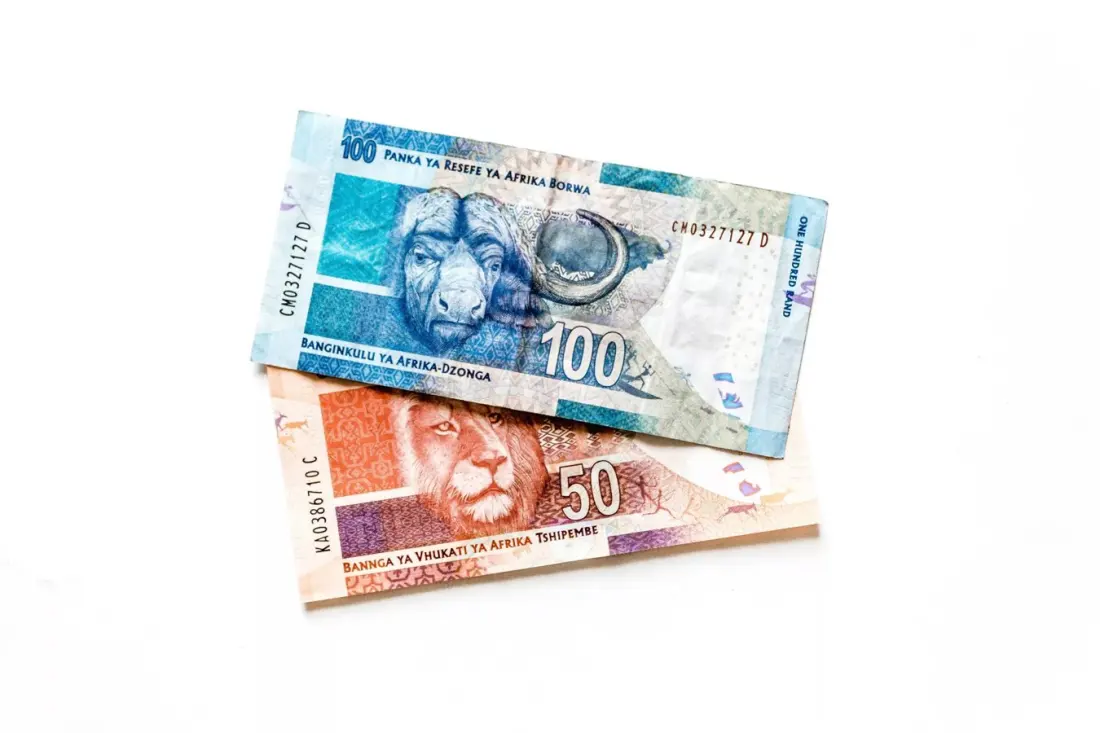
Cash still talks in much of Africa — and it also shows you where to go. A 2024 study in People and Nature analysed 4,541 banknotes from 207 countries and found that African currency features mammals more than any other region's. Looking at the notes themselves, Getaway South Africa picked five countries whose money points straight to a destination.
Zambia's kwacha is the waterfall note. The Bank of Zambia's Heritage Series depicts six waterfalls alongside wildlife and indigenous plants. Victoria Falls — Mosi-oa-Tunya, 'The Smoke That Thunders' — tops the list, where the Zambezi drops into a gorge on the Zimbabwe border. But the country has quieter options too: Kalambo Falls near the Tanzanian border, plus Lumangwe and Chishimba Falls further west.
Botswana's P50 shows the Okavango Delta as it should be seen — from a mokoro, the traditional canoe poled through reed channels, with a fish eagle overhead. Seasonal floodwaters spill across the Kalahari sands here, creating a wetland of lagoons and islands. Gliding at water level is a slower, quieter alternative to a game drive, and walking safaris are possible depending on water levels.
The Seychelles' 2016 series swaps beach imagery for biodiversity, featuring the coco de mer palm and the Aldabra giant tortoise. On Praslin, the Vallée de Mai Nature Reserve, a UNESCO World Heritage Site, protects a forest of palms whose seeds are the largest in the plant kingdom. Remote Aldabra Atoll holds one of the world's biggest giant tortoise populations, with access tightly controlled.
South Africa's rand pairs Nelson Mandela's portrait with one of the Big Five on the reverse — rhino, elephant, lion, buffalo or leopard. The animals map neatly onto safari styles: Kruger for classic game viewing, or self-drive routes and public camps in national parks if a private lodge is out of budget. The notes also tell a political story — Mandela replaced Jan van Riebeeck, putting the country's first democratic president front and centre.
Zimbabwe's upgraded Big 5 ZiG series matches five landmarks with five animals: the Matobo Hills with their granite formations and rock art, the Parliament building, Kariba Dam with its boating and fishing reservoir, Victoria Falls, and the Great Zimbabwe ruins. The last is the standout — monumental stone walls built and expanded between roughly the 11th and 15th centuries, remnants of a major pre-colonial trading civilisation.
The takeaway for travellers is simple: the imagery on African currency is a ready-made itinerary, and the wildlife it celebrates is under real conservation pressure, so visiting responsibly matters. Next time you get change at a border post or market stall, flip the note over — it may have planned your next stop for you.