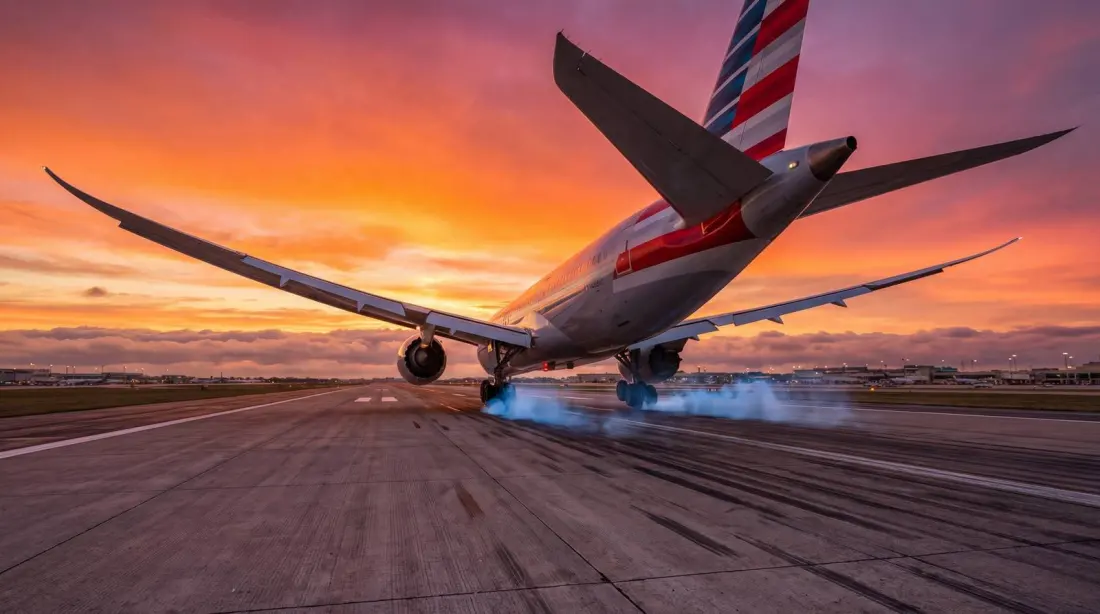
An American Airlines Boeing 787-8 flying from Barcelona to Chicago declared an emergency on Tuesday afternoon after the crew flagged a problem with one of its brakes shortly before landing. Flight AA41 touched down at O'Hare International Airport around 2:30 PM local time with 234 passengers and 11 crew on board — and then stopped on the runway with two flat tyres.
During the final approach, one of the pilots told air traffic control that the aircraft had a right brake that "might be dragging" and requested that emergency crews follow the jet in. Passengers described a loud bang at touchdown; one told ABC News there was a "really big boom" as the wheels hit the tarmac. The plane, an 11-year-old Dreamliner registered N806AA, sat at the far end of the runway before everyone was taken off via stairs and bussed to the terminal. The Chicago Fire Department took one person to a local hospital in good condition — it hasn't been confirmed whether that person was a passenger or a crew member.
So what actually goes wrong when a brake "drags"? A dragging brake stays partially applied without the crew commanding it, so one wheel is fighting friction while the rest of the plane rolls freely. At landing speeds that can lock the wheel, scrape the tyre along the runway, or build up serious heat — hot enough, in extreme cases, for fusible plugs in the wheels to melt and deliberately release tyre pressure to prevent a worse blowout. American hasn't said what caused the fault, and the FAA is investigating while the aircraft stays out of service in Chicago.
Notably, this is the latest in a string of tyre-related incidents at O'Hare. August alone saw a United takeoff aborted on blown tyres on the 13th, two separate landings ending in blown tyres on the 17th (American AA386 and United UA739), an American 737-800 tyre failure while taxiing on the 21st, a Republic Airlines braking issue on the 25th, and American AA3280 losing two right main gear tyres during taxi the next day. Investigators haven't found a common cause across the cluster, but the pattern is unusual enough to have drawn attention.
For anyone flying, the reassuring part is how these events typically end: crews spot the issue, declare a precautionary emergency, and land with fire crews standing by — exactly what happened here. Delays and missed connections are the most likely knock-on effect for travellers, not danger. If you're booked on a transatlantic 787 service, incidents like this are a reminder that the safety choreography around a landing is extensive, and that a flat tyre is a nuisance handled on the ground rather than a crisis in the air.